
Graduates
- Scored 40+ in the IB and 7s in the subjects they teach.

Help your child succeed in the IB MYP. Learn the framework, 5 top benefits, and how this secondary education builds critical academic skills for the IB DP and life.

As a parent, you always want the very best for your child. It’s perfectly sensible for you to want to learn everything you can about the International Baccalaureate (IB) Middle Years Programme (MYP).
Finding a straight answer is always challenging. Depending on whom you speak to, the MYP certificate is either a heaven-sent opportunity. Or it sounds like a total nightmare.
As MYP and IB graduates, the dedicated tutors at Lanterna Education are here for you. We want to give you as much information as possible and make it easy for you and your child to find what’s right for them – while ensuring they reach the academic minimums they need to follow their dreams.
Scroll down to find the five benefits of the IB MYP certificate and how the curriculum prepares your child for high school, the IB’s high school diploma programme, university, and, ultimately, life!
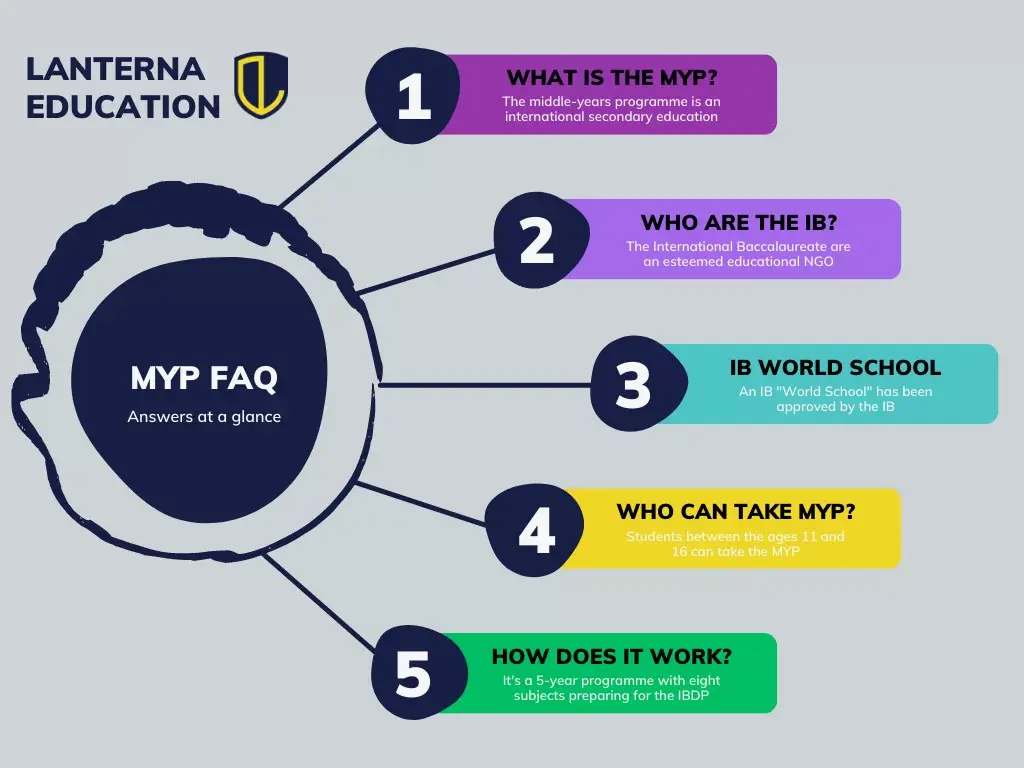
Before we start listing the benefits of the MYP, let’s look at the IB Middle Years Programme and answer your questions about its educational framework.
MYP is an acronym, and as you’ve probably already figured out, it stands for International Baccalaureate Middle Years Programme.
The MYP is an international secondary education programme offering a pre-IB curriculum to help learners develop critical thinking, academic and social skills, emotional intelligence (EQ) and physical health.
The IB Middle Years Programme (MYP) tries to grow students holistically. They nurture active learners and young minds teaching them how to empathise with others, consider global contexts, and build a successful life full of purpose and continuous growth.
The International Baccalaureate (IB) started in 1968 in Geneva and was initially known as the International Baccalaureate Organization (IBO).
The IB have an NGO consultative position at UNESCO (UN Educational, Scientific, and Cultural Organisation). And they collaborate with the Council of Europe and OIF (Organisation Internationale de la Francophonie).
Basically, the IB is a credible educational NGO that offers educational programmes to prepare students for further studies and a successful career. The IB coordinates with governments and other NGOs worldwide to align IB programmes (and what students study in the classroom) with a country’s national curriculum.
Want to know more about the International Baccalaureate (IB) diploma programme? Read this post to discover why it’s an excellent way to prepare your child for university admissions.
What are IB World Schools? “World school” is the term the International Baccalaureate (IB) uses to describe various educational institutions and organisations worldwide with IB approval. Yes, you read that correctly; Schools need International Baccalaureate (IB) approval to offer IB programmes!
Any establishment or organisation that offers the IB MYP (Middle Years Programme), the IB DP (International Baccalaureate Diploma Programme), or any other IB programme must meet specific standards to earn International Baccalaureate approval. They have a global International Baccalaureate World School community as a result.
As an NGO, the International Baccalaureate (IB) develops partnerships with local school leaders and international schools to offer thousands of middle school students the IB Middle Years Programme (and other IB programmes).
The IB’s authorisation process is just one of the ways the International Baccalaureate ensures students in different international schools get the same high-quality secondary education through the middle-year programme. No matter where they live!
Local middle schools and IB World Schools in the US, UAE, Europe, and beyond offer International Baccalaureate programmes to students.
In fact, over 5,000 schools in more than 100 countries currently use the IB’s programmes to develop critical thinking and to start preparing students for further studies and their academic journey.
So children just about everywhere can do the MYP! But, it’s important to remember that the Middle Years Programme (and other IB courses) have set student age limits.
The International Baccalaureate (IB) offers the Middle Years Programme (MYP) to nurture pre-teen and teen learners, so the MYP age limit is 11 to 16 years old.
The age limit is in place because the International Baccalaureate’s (IB’s) secondary education programme is for adolescent students. So if your teen is over 16, they should look at the IB’s Diploma Programme (DP).
The Diploma Programme (IB DP) is for high school students and young adults (16 to 19 years old). Its syllabus focuses on preparing students for university admissions and life after school. Learn more about the IBDP here.
Is your child independent, a ‘Thinker’? Do they have an ever-inquiring mind? Your child may have a huge heart, an open mind, and a caring nature.
If you Say ‘Yes’ to any (or all) of the traits we mentioned, your child might be a perfect candidate for any International Baccalaureate (IB) programme!
The International Baccalaureate develops programmes and syllabuses, and their student profile describes learners who benefit most from the IB’s educational framework:
The MYP is a 5-year programme. Its curriculum has six key focus areas: Creative, Global, Intellectual, Social, Physical, and Personal. International Baccalaureate (IB) Middle Years Programme (MYP) learners also have eight mandatory subjects. Yes, students learn 8 subjects!
In the MYP, students study a range of subjects and ideas. And each subject group requires 50 hours of teaching (at least!) every year. The MYP offers the following subject groups:
In summary, Middle Years Programme students complete eight academic subjects, requiring at least 50 hours of teaching every year for five years. And do several tests and projects!
Students in the International Baccalaureate Middle Year course have to learn at least two languages. Before you panic, we didn’t say “2 other languages.
Students can select two languages: an ‘instructional language” and one “additional language.” Instructional language (aka Language A) is the student’s primary language.
For example, an MYP student who chooses English will receive tests, lessons, project briefs, etc., in English.
While the IB MYP’s “additional language” (aka a student’s Language B) is the language middle school, students choose to study for the IB’s Language Acquisition subject group.
The IB also requires learners to take part in coursework and long-term personal projects that encourage interdisciplinary learning. These assessments teach students how to improve their own learning experience, develop academic abilities and use critical thinking.
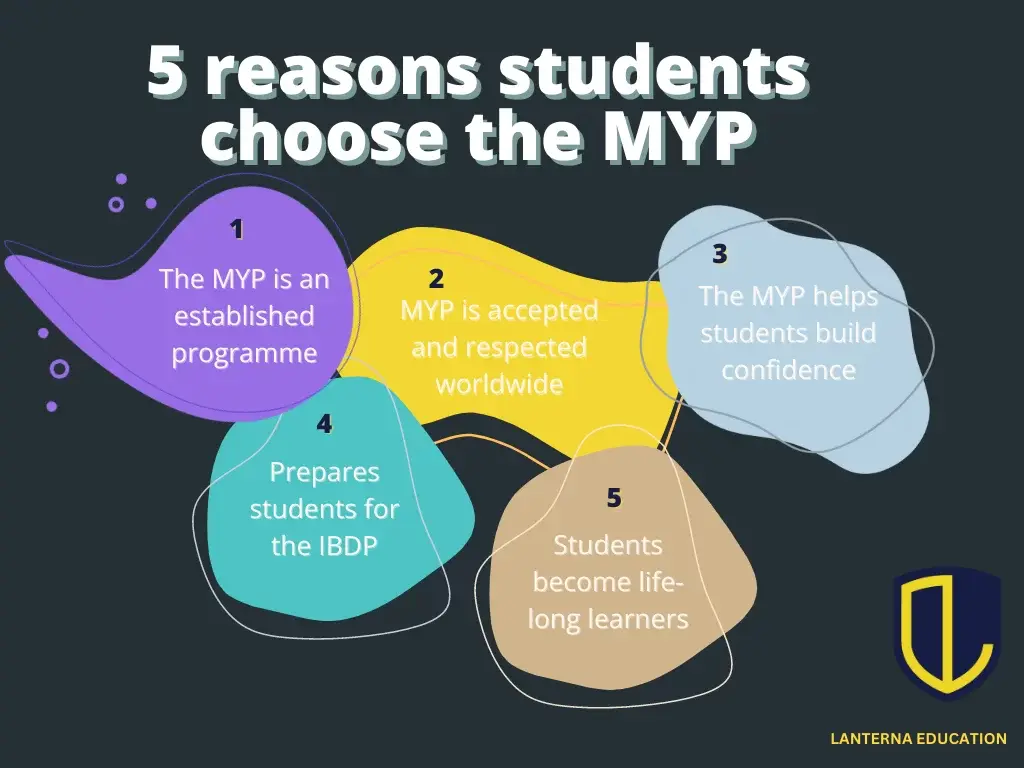
Here is a breakdown of the top 5 reasons middle school students should take the IB Middle Years Programme (MYP):
At first, students around the world knew the IB Middle Years Programme (MYP) as the IBO MYP. Because in 1994, when the Middle Year Programme launched, the International Baccalaureate (IB) was the International Baccalaureate Organization (IBO).
Why are we telling you all this? To explain how much experience the International Baccalaureate (IB) has nurtured in curious minds. And how long they’ve helped students develop skills.
The NGO updated the programme twenty years after the International Baccalaureate (IB) started offering the Middle Year Programme to IB schools (2014, to be exact!). And this review is just one of the reasons the IB is a world-renowned secondary education programme!
The International Baccalaureate (IB) relooked the MYP subject groups and curriculum to ensure it encourages students to develop intercultural understanding, think for themselves, and improve their social skills.
The IB Middle Years Programme’s (MYPs) framework and assessment methods review is as important as the IB Middle Years Programme’s history and credentials. We say this because the MYP review means international schools and students taking International Baccalaureate MYP programmes everywhere receive the same quality of education. No matter where they are, students learn relevant skills like critical thinking, independent thought, and time management. At the same time, they prepare for the International Baccalaureate (IB) Diploma Programme (DP), university admissions, and more.
The MYP certificate is internationally accepted. This means students can take their MYP secondary education qualification or course results virtually everywhere!
The International Baccalaureate (IB) Middle Years Programme is in over 108 countries. In more than 5 000 schools! It’s one of the world’s most popular international secondary education programmes.
The International Baccalaureate (IB) MYP meets international education standards through active, inquiry-based learning. The International Baccalaureate (IB) aims to shape young minds and produce future leaders – Worldwide! Unlike a country’s usual national curriculum, the IB’s internationally recognised curriculum encourages students to focus on language acquisition, develop intercultural understanding, and build critical thinking skills.
Middle school students can build confidence by doing the MYP?? Yes! The IB Middle Years Programme helps students develop confidence allowing learners to develop professional and vocational skills and teaching them self-management.
The International Baccalaureate MYP curriculum lets students develop social and critical thinking skills while they gain other confidence-boosting skills and knowledge (like learning how to fact-check!). Students in the MYP learn how to:
And so much more! All the skills developed over the 5-year Middle Years Programme (MYP) help prepare students for the IB DP, and trains students to trust themselves and believe in their academic capabilities.
How do IB Middle Years Programmes prepare students for life? The curriculum! The MYP curriculum uses inquiry-based learning to encourage students to explore subjects (or topics) of interest.
Yes, the IB programme for middle school-aged students will help your child transition to the IB diploma programme. And looks great on university admissions transcripts! Projects and assessments offer opportunities for holistic growth. It doesn’t only improve academic performance.
To explain, here’s how the International Baccalaureate (IB) incorporates interdisciplinary learning into the Middle Years Programme (MYP) coursework and assessments:
We’ll use MYP Language and Literature individuals as an example. In IB Middle Years Programme (MYP) Language and Literature, individuals read poetry, give oral presentations, and students complete essays and other written tasks. All the usual work you’d expect from a student learning a language subject. Right?! Except, Middle Year Programme (MYP) students do loads more!
Language and Literature individuals do their regular coursework. Plus, students complete different assessments for eight subject groups too. The Middle Years Programme (MYP) curriculum and the personal projects actually show students how to harness and use their natural curiosity to develop vital skills and reach their full potential.
As MYP and IB graduates, we promise you that managing all eight subjects, meeting personal project demands, and being responsible for your own learning doesn’t only start preparing students for further education.
It prepares learners for the rest of their academic journey (whether it includes the IB DP or not) and a successful career. The programme gives pupils the knowledge, skills, and habits they need to succeed in their academics, careers – life!
The International Baccalaureate (IB) Middle Years curriculum centres around teaching learners to think. MYP students must examine, research and consider a range of subjects while taking local, national, and global contexts into account.
The MYP encourages students to develop skills through practical education and using learning resources outside the classroom. The MYP programme teaches students to consider different contexts, think of global perspectives and foster intercultural understanding.
Ultimately, the MYP aims to develop thinkers – students who approach challenges, consider different perspectives and challenge assumptions and biases.
The Lanterna Education team have years and years of experience (over 19 years!) helping IB students complete coursework, choose their personal projects and ACE their assessments.
As successful IB graduates and tutors, we have excellent advice for students taking the Middle Year Programme (and their parents!). To ensure a holistic approach to academic success, we believe in fostering not only subject-specific knowledge but also essential skills like critical thinking and effective communication. Our commitment extends beyond traditional tutoring, encompassing a range of educational resources and personalized, one-on-one tutoring sessions designed to prepare students for growth throughout their MYP journey and beyond. We also recognize the importance of cultivating a resilient exam mindset for IB students.

Ultimate IB Program Guide: Explore PYP, MYP, & DP. Get clarity on benefits, workload, and global university recognition for students. Free guide from IB 7 grads.
IB MYP vs. GCSE: Is the Middle Years Programme right for your child? Our parent's guide explains the IB MYP curriculum, assessment, and comparison to the GCSE system.

Ease the MYP to DP "shock"! Guide for parents and students on the transition, highlighting the shift from criterion-based to exam-heavy assessment and suggesting summer prep.
A complete guide to the IB Diploma Programme. Understand its core components (TOK, EE, CAS), subject groups, and grading system. Learn why the IB offers outstanding preparation for university.
Understand the International Baccalaureate (IB) program: its diploma structure, core components (Extended Essay, CAS, TOK), curriculum, and benefits for university success.
Understand the IB Diploma Programme curriculum, subjects, and core elements (CAS, TOK, EE) with this expert guide. Learn how IB assessments and grading work.

Learn how the IB MYP E-Assessments work, including key facts, grading (max 56 total), and the mandatory Personal Project. Get expert insights into this unique assessment model.

Master your IB MYP Personal Project with 4 expert tips on choosing a topic, understanding grading criteria (A-D), and maximizing your supervisor connection.
600+ handpicked tutors from across the world with the best background and experience.

Geography shouldn't limit your potential. Lanterna provides premium online IB tutoring across the world, being partners with 250+ IB schools worldwide. Our country guides explore how the IB landscape shapes up and how our tutoring supports it perfectly.

1 hour of online tutoring in any subject with a 40+ IB graduate who scored a 7 in your subject.
No strings attached. By filling out the form you accept our T&Cs.
We are IB experts committed to achieving your academic goals.