
Graduates
- Scored 40+ in the IB and 7s in the subjects they teach.

Master your IB Mathematics IA. Learn how to choose a great topic, structure your exploration, and understand the 5 official grading criteria for top tips.
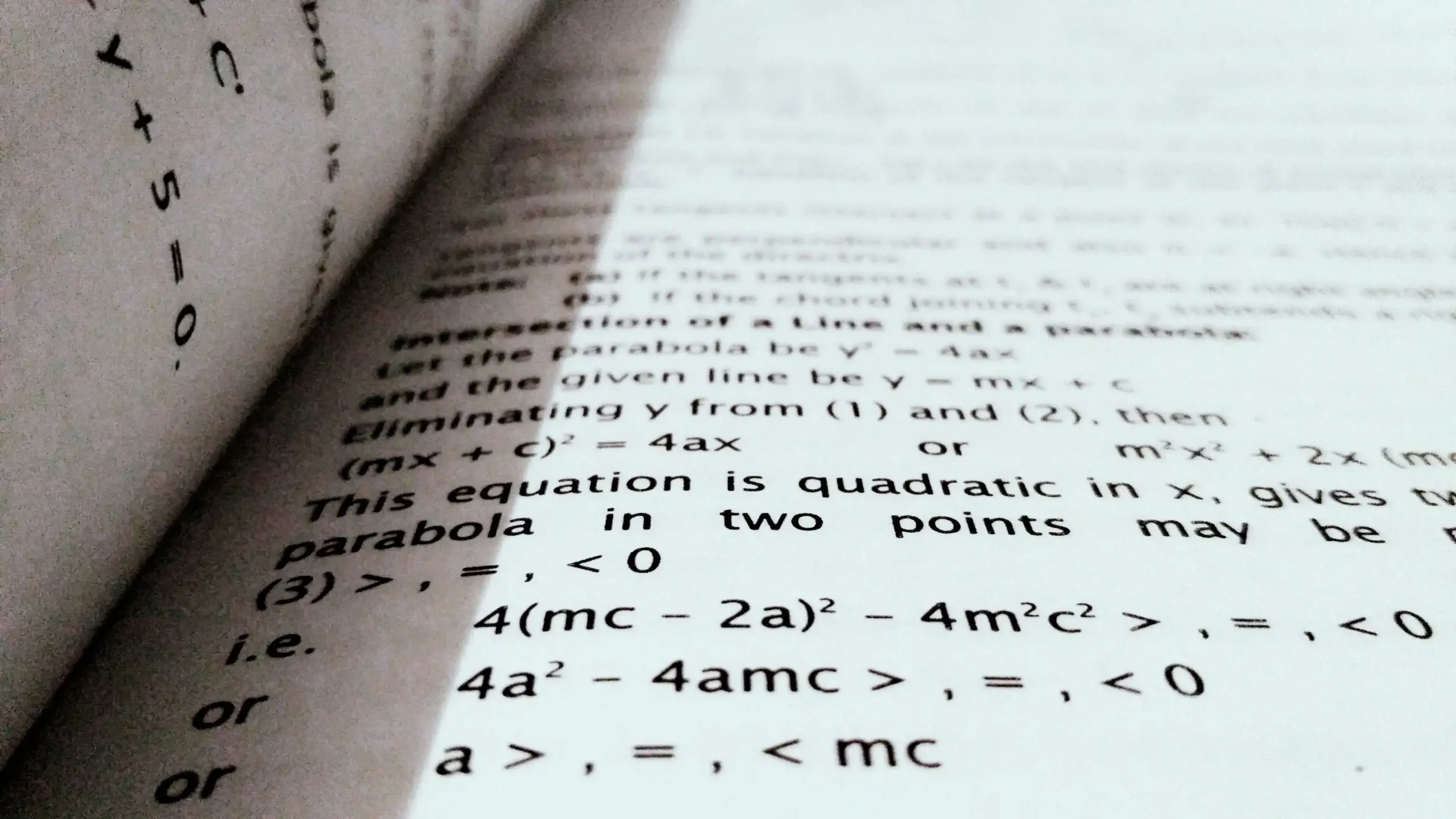
For your Mathematics Internal Assessment, you have to complete a Mathematical Exploration on a topic of your choice. Whilst sometimes feared by students, this is a chance for you to explore an area of mathematics that interests you! It is a piece of written work that is graded out of 20 marks in total and contributes to 20% of your total grade. Here we look at the structure of the assessment, how to choose a topic, how to lay out your assignment and what to include.
The Maths IA forms 20% of your overall grade for Maths studies, SL and HL. The IBO recommend that it is 6-12 pages in length and includes maths that is commensurate with the level of difficulty of the course. This can be partly formed by maths studied within the IB maths syllabus, but it is also recommended that you look elsewhere for inspiration.
You could look at the optional modules (available at HL) that you do not study for potential starting points and build from here. Alternatively, think about an area which interests you where maths could be applied. If you’re looking for tailored support on your IA or need help mastering other IB subjects, check out our 1:1 Tutoring offering for expert guidance from experienced tutors who know the IB inside out.
The Lanterna Tip: Personally, I chose to investigate the bottle flip for my Maths IA as this became well known whilst we were preparing our IA ideas. Choosing something personal will allow you to score highly on the personal engagement criteria, which we will talk more about below.
A good way to structure your internal assignment would be the following:
Whilst this is a good way of approaching the assessment, the IBO state that this is definitely not the only way. If you think there is a better way do use it as this may allow you to show personal engagement and score highly.
The IA marking criteria are split into 5 categories, which we break down below:
The way you communicate in the Internal Assessment needs to be coherent, well organised, concise and complete. Conciseness has been emphasised as the IBO have recognised that some IAs have been too long and this has detracted from the quality of students’ work. To reiterate, 6-12 pages of concise and rigorous critical thinking is a good guide regarding how much to write.
In addition, the IBO have recommended that all graphs, tables and diagrams should be embedded in your main body (not as appendices). This will help the examiner read through your work clearly and so will improve your chances of scoring a better mark. Similarly, citing when and where other people’s ideas are used throughout your essay is key, as well as having a bibliography at the end. This will ensure you steer clear of plagiarism by highlighting to the examiner which work is your own – which will also improve your chances of scoring highlight in personal engagement.
Firstly, the IBO recommend that you define key terms where required. Definitions, which can be found in textbooks or journal articles (please remember to reference!), will help the examiner follow your exploration and shows that you understand the topic. Similarly, ensure that you are using appropriate mathematical language such as notation, symbols and terminology. Try not to be too complex in the language you use as, if used wrongly, this may show a lack of understanding and drag both your mathematical presentation and communication marks down. However, please do use mathematical language where necessary. Define it, and explain clearly what it is referring to in your exploration.
Furthermore, try to make your work look visually pleasing by using multiple methods of presentation. These may be formulae, diagrams, tables, charts, graphs or models, and should be used to demonstrate your understanding of the topic. Please type out your own equations and draw your own graphs (for example, use Desmos and print screen, limiting any branding that is visible) and ensure all graphs have axes labels and headings. Finally, and most importantly, ensure all graphs have a purpose! This will demonstrate an ability to critically highlight the key elements of your exploration in a concise and coherent manner.
Often the trickiest of the 5 criteria to score highly in, personal engagement requires you to demonstrate your connection with the topic. There are a number of things you can do that will improve your mark in this criterion:
Proving yourself wrong or getting a result you were not expecting is not necessarily a bad thing as it will offer you a chance to reflect and score highly on this criterion. Try to recognise what caused the result that you were not expecting and, as importantly, how this could be fixed. Also reflect on the successes of your exploration – Did you succeed in proving something, obtaining an optimum result or modelling a difficult concept? Discussing both the strengths and the weaknesses of your work here will help you to score highly.
Moreover, try to discuss different approaches that you have taken or could have taken and how these may have impacted your results. For example, did you use a simple model to begin with (as I did in my IA), which allowed you to isolate the key equations, and build a more complex structure from here? Evaluating potential approaches from different perspectives will show strong critical analysis.
Furthermore, if you have space you could discuss the implications of your work or areas for further exploration. Do the results you have obtained imply any policy changes or develop our understanding of a topic area? Alternatively, could you apply your research to other fields, or explore further areas within the topic? If so, please try to include these to score highly for reflection.
Unlike many people think, you do not have to use mathematics that is way beyond the course level to score highly on this criterion. The IBO recommend that you use maths that is “commensurate with the level of your course”. This may take a syllabus topic, such as calculus, and develop it to go beyond what is covered in the IB course. Alternatively, it may apply this knowledge to a new scenario, as I did using differentiation when modelling the bottle flip. Ensure that, whichever level you choose, your exploration remains at a level where you can include “creativity or (a) personalised problem” to ensure you score highly on the personal engagement criterion as well.
One useful source of topics could be the optional modules that you do not cover as part of your course. If you are a Standard Level mathematician you have free reign to choose one of the Higher Level optional modules for inspiration. For example, a student interested in computer science may choose to explore the use of Dijkstra’s and Kruskal’s algorithms in graph theory. It is important to remember that the IB is more concerned about how you show your knowledge and understanding of the mathematical topic you choose. Sophisticated mathematics may include understanding and use of challenging mathematical concepts, looking at a problem from different perspectives or seeing underlying structures to link different areas of mathematics. The maths need not be complicated, just well explored.
Once you have written your exploration, it is important to proof read it and ensure that there are no grammatical errors and all references use the same structure. Moreover, please make sure that all of the 5 areas listed in the mark scheme have been addressed explicitly.
Whichever topic you choose to do your Maths IA on, there are 3 important things to remember:
Best of luck!!
.png)
Master your IB Math AA IA with this comprehensive guide. Find perfect topic ideas that allow deep mathematical exploration, expert examples, structure tips, and common mistakes to avoid for a 7-level score.
.png)
Struggling with your IB Math AI IA? Our complete guide breaks down the marking criteria and structure. Find a great topic with our expert tips and successful examples.
Choosing between IB Math AA vs AI? Our guide compares the syllabus, difficulty, and university prerequisites for both SL and HL. Make the best choice for your future.

Learn how to structure and format your IB Math IA for top marks. Understand the grading criteria and optimal layout used by high-scoring students.
Struggling to find an IB Maths IA topic? Explore 50 proven Maths IA topic ideas, hand-picked by an IB expert to inspire your exploration and help you score highly.

Master your IB Maths exams with expert study and calculator tips. Learn essential GDC functions, effective revision strategies, and how to target your weaknesses.
Master your TI-Nspire for IB Math A&I exams. Get expert calculator tips on N-Solve, Linear Regression, and Probability Distributions to minimize mistakes and maximize scores.

Confused by the new IB Maths courses? Learn how to choose between Analysis and Approaches and Applications and Interpretation at SL or HL with this expert guide.
600+ handpicked tutors from across the world with the best background and experience.


Geography shouldn't limit your potential. Lanterna provides premium online IB tutoring across the world, being partners with 250+ IB schools worldwide. Our country guides explore how the IB landscape shapes up and how our tutoring supports it perfectly.

1 hour of online tutoring in any subject with a 40+ IB graduate who scored a 7 in your subject.
No strings attached. By filling out the form you accept our T&Cs.
We are IB experts committed to achieving your academic goals.