
Graduates
- Scored 40+ in the IB and 7s in the subjects they teach.

Master the IB with proven note-taking methods (Cornell, Mind Mapping). Discover the best apps and strategies to revise faster and retain heavy IB content with this ultimate guide.
The IB Diploma is a marathon, not a sprint. The sheer volume of content across all your subjects, plus the demands of IAs, CAS, the EE, and TOK, can feel overwhelming. At Lanterna, we've been through it ourselves, and we know that across subjects, there's one skill that is essential for managing your work and actually understanding- not just memorising- your content, making the difference between surviving and actually thriving in the IB: effective note-taking.
This guide cuts through the noise. We're giving you the premium, modern strategies that top-scoring IB students use to turn note-taking from a passive chore into an active learning powerhouse. Master these, and you won't just remember more content; you'll understand it on a deeper level and make revision infinitely more efficient.
This isn't just about writing things down. It's about building a system for success. By the end of this guide, you'll be able to:
In the IB, you're not just memorizing facts for a test. You're building connections, evaluating arguments, and thinking critically. Simply highlighting a textbook or passively re-reading slides won't get you the top marks. Effective note-taking forces you to engage actively with the material. You'll be investing in a personalised database of information, to make future revision and testing easier. It helps you:
Let's get into the practical strategies. Don't feel you have to pick just one—the best students often blend these methods depending on the subject or the stage of revision, e.g. using the Cornell Method to understand all the key concepts, drawing a mindmap to ensure your understanding is comprehensive, then making flashcards for an easy active recall method. Every student is different and there is no "one perfect studying method". Remember that it may take time to find what works, but these are some methods that can serve as a starting point to create your own, personalised strategy.
This is a classic for a reason. It's perfect for content-heavy subjects like History, Biology, Economics, and Business Management where you need to digest lectures and textbook chapters efficiently.
How it Works: Divide your page into three sections.
| Cue Column | Main Notes Area |
|---|---|
| After the lesson, pull out key terms, dates, or questions from your main notes. This is for active recall. | Take your main notes here during the class or while reading. Use bullet points, abbreviations, and shorthand. Don't worry about being neat. It's here you'll be addressing any confusion/knowledge gaps. |
| Summary Section: At the bottom, write a 2-3 sentence summary of the entire page. This forces you to synthesize the key takeaways and is useful when sorting notes. | |
Mind mapping is a game-changer for visual learners and for subjects that are all about interconnected ideas. Think TOK, Literature, Chemistry (organic pathways), or planning your EE and IAs.
How it Works:
Don't dismiss the classic outline. For subjects with a clear, logical structure like Mathematics, Physics, or step-by-step processes in Computer Science, this method provides unbeatable clarity. You can make it more visually interesting using highlighters, drawing diagrams, underlining, etc. By helping pages be distinct, it can avoid the intimidating "mass of text" where notes blend together and the idea of reviewing it all seems colossal.
How it Works: It’s all about hierarchy. You create a logical flow from the general to the specific.
Leverage technology to make your notes searchable, accessible, and more powerful. Here are some of our favourites:
Best for creating an interconnected "second brain." You can link notes together, build databases to track IA progress, and create a personal wiki for each subject. Steep learning curve, but incredibly powerful for seeing the big picture.
The digital workhorses. Think of them as infinite digital binders. You can create notebooks for each subject, type or write notes, embed PDFs and images, and record audio. Their search function is a lifesaver.
Essential for tablet users. These apps perfectly mimic the pen-and-paper experience but with added benefits like PDF annotation, shape-drawing tools, and seamless integration of text and images. A must-have for Math and the Sciences.
If you love mind mapping, these dedicated apps allow you to create beautiful, complex maps quickly. They're great for brainstorming and can often export your map into a linear outline, giving you the best of both worlds.
Taking great notes is only half the battle. The real magic happens when you use them to study smart.
.png)
Master IB note-taking with the ultimate guide. Discover top methods (Cornell, mind maps) and review essential apps (Notion, OneNote) to boost revision and study efficiency.
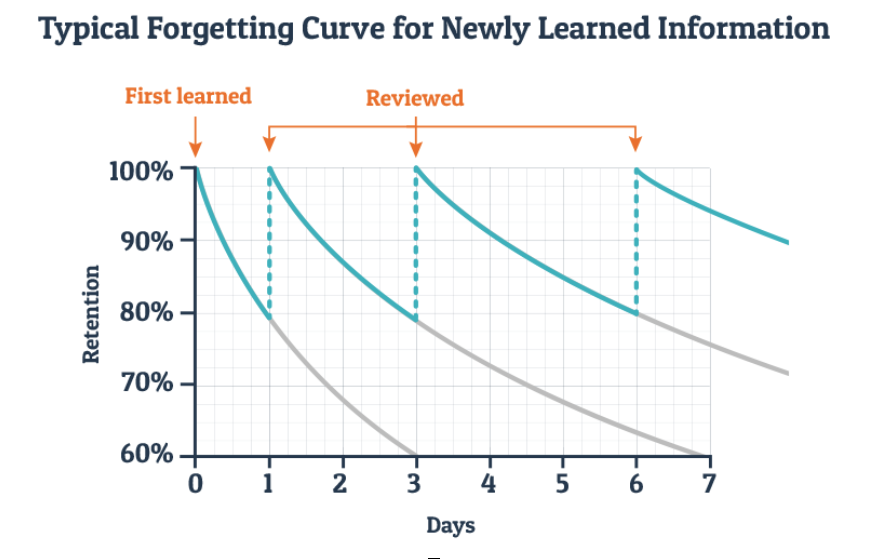
Learn how to optimize your IB note-taking process with expert revision tips, transforming messy notes into life-saver resources for long-term retention and exam success.
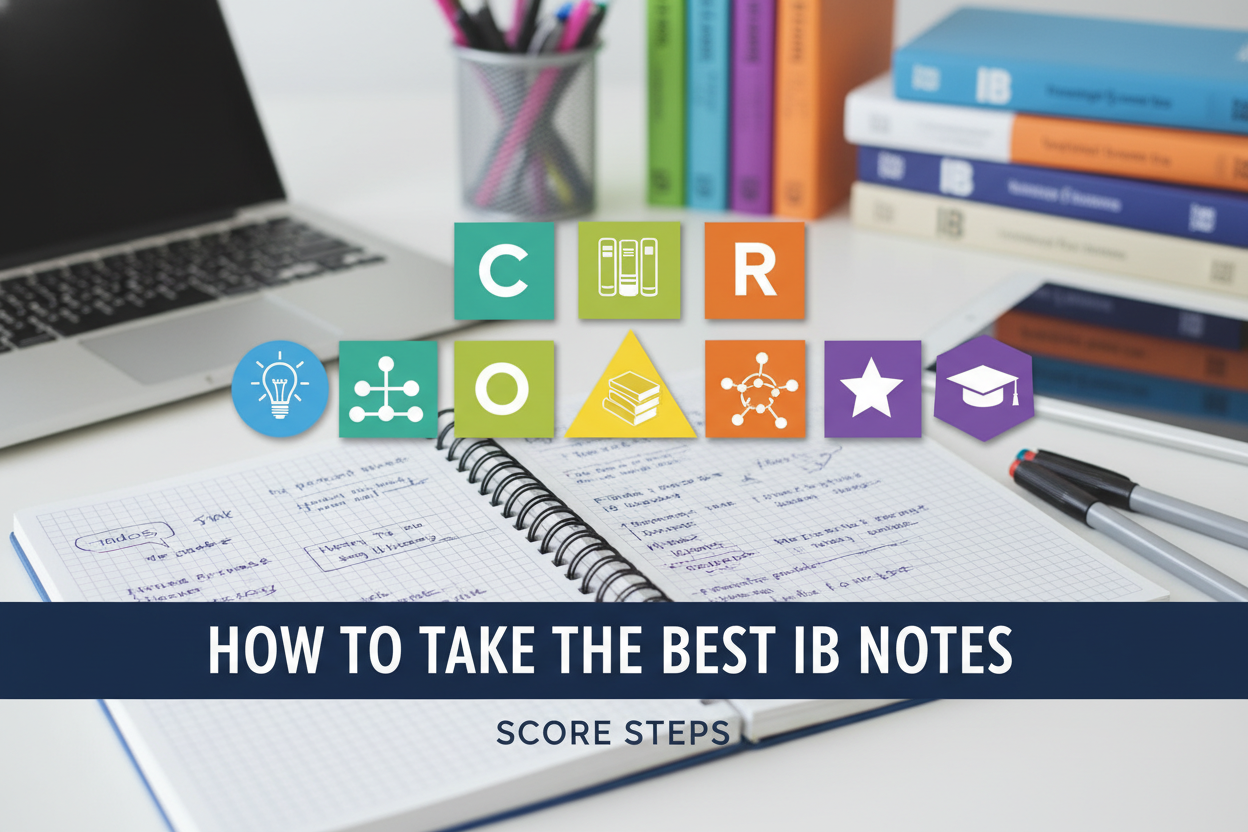
Learn how to take the best IB notes using the expert SCOR E steps: Select, Condense, Organise, Revisit, Engrain. Essential IB revision tips for success.
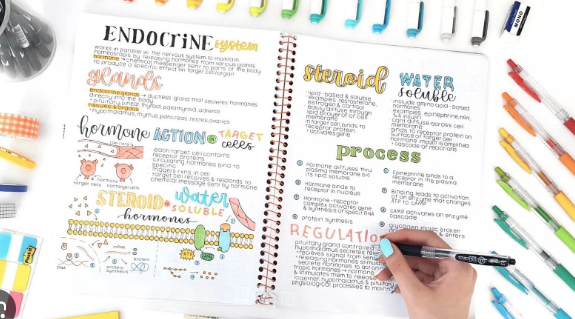
Learn how to take effective IB notes with expert revision tips on content and form. Discover methods like Cornell, visual diagrams, and flashcards for better studying.

Learn how to take effective IB notes with expert tips on condensing information, sticking to essentials, and using your own words. Ace your IB revision and exams.

Master the demanding IB environment. Get essential tips and strategies on how to stay organized, manage your time, and set yourself up for success in the Diploma Programme.
.png)
Master IB organization and conquer overwhelm! Get expert tips to manage EE & IA deadlines, prioritize tasks, and build a balanced study schedule without burnout.

Boost your IB study sessions with our top 5 IB study apps and websites recommended by expert tutors. Get better time management, effective revision tips, and control over assignments.
600+ handpicked tutors from across the world with the best background and experience.


Geography shouldn't limit your potential. Lanterna provides premium online IB tutoring across the world, being partners with 250+ IB schools worldwide. Our country guides explore how the IB landscape shapes up and how our tutoring supports it perfectly.

1 hour of online tutoring in any subject with a 40+ IB graduate who scored a 7 in your subject.
No strings attached. By filling out the form you accept our T&Cs.
We are IB experts committed to achieving your academic goals.