
Graduates
- Scored 40+ in the IB and 7s in the subjects they teach.

Learn how to select the easiest IB subject combination for a higher score, according to 2019 statistics. Discover which courses offer the best chance for grading success.
We’ve all heard the myths about the IB, right? The stories that say that the IB is impossible no matter what courses we take. But how can we cut some corners, and make our IB – statistically – as easy as possible? Here at Lanterna, we’ve had some fun looking at the 2019 IB graduation statistics to uncover the easiest IB subject combination you can take. These calculations are not meant to be taken as instructions on how to choose your IB courses, rather an interesting consideration of recent statistics.
At Lanterna we have over 300 tutors who smashed the IB. They know exactly how to get a 45 and can give you tips and tricks on how you can do the same. What are you waiting for? Get your own tutor today!
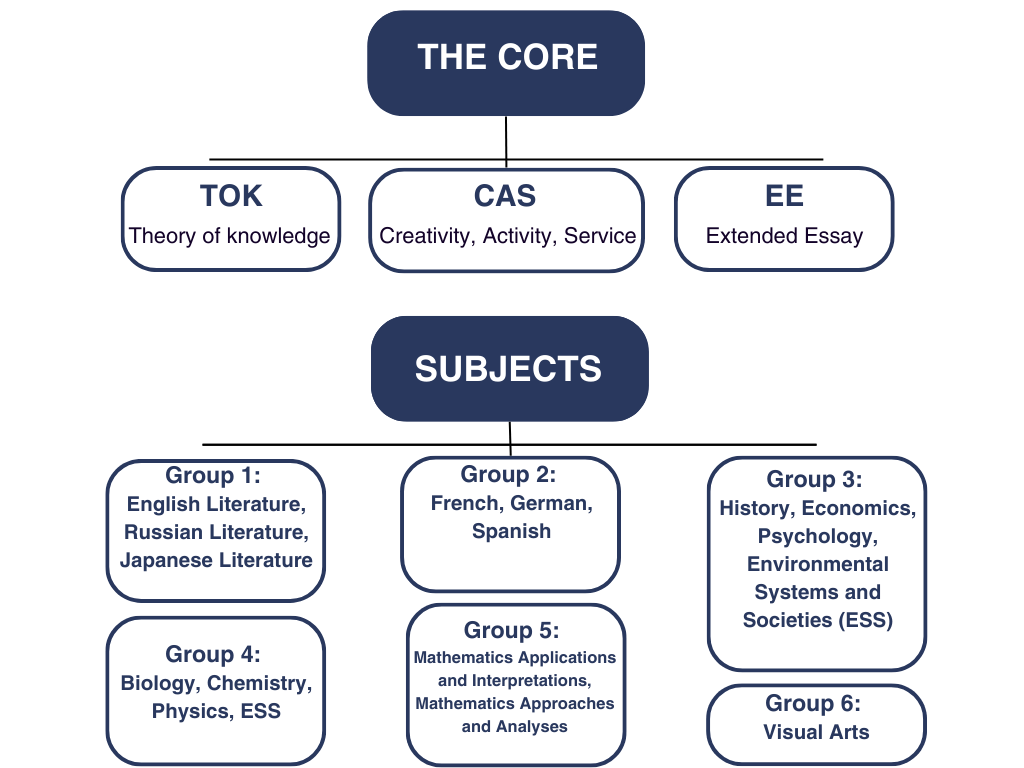
When it comes to choosing your English course, the stats suggest sticking with Language & Literature over choosing Literature. Lang & Lit students have on average a 0.19 points higher score than Literature students along with a 3x lower risk of failing. Don’t be fooled though, although the average score in English A Language & Literature SL is relatively high, only 3.8% of students got a 7, so it’s not guaranteed success!
The only two languages that fulfilled our requirement of at least 7,000 candidates in 2019 were Spanish and French, and Spanish takes the crown! The average score for a Spanish student was 0.1 points higher than that of a French student. Surprisingly, the average score for Spanish B HL (5.32) is significantly higher than Spanish B SL (5.03). Additionally, 15.1% of Spanish B HL candidates achieved a 7, one of the higher percentages of any courses in 2019!
The stats suggest that Economics is significantly easier than Business Management, History, or Psychology, beating out the other 3 common social sciences comfortably. It seems that last year taking Economics HL proved easier than Economics SL, as the average score for the higher level course was a full 0.43 points higher than the standard level equivalent! Additionally, a full 12.3% of candidates in Econ HL got a 7, that’s 6x higher rate than in History, 2x the rate in Business Management, and 4x the rate in Psychology.
Explore our comprehensive collection of study materials to boost your understanding and grades in Biology. Access them now!
This is an interesting one. All three HL courses (Chem, Bio, and Physics) actually have higher average scores. However, we’ve gone with Biology SL from group 4 in order to ensure you have 3 HL’s and 3 SL’s, and the difference between the higher and standard level courses within the sciences are not as great as they are in some of the other groups. Out of the 4 eligible SL sciences (Chem, Bio, Physics, ESS), biology comfortably has the highest average score at 4.18, beating all the other courses by at least 0.1 points!
Controversial, we know. However, by our rules, the easiest IB subject combination is the one with the highest average scores and the average score in Maths HL is actually a full 0.5 points higher than in Maths SL! This is clearly because of selection bias, as the people choosing to take Maths HL are those who are already strong in the subject. So, if you’re using this article to choose your IB diploma, don’t take Maths HL just because it’s on this list! However, if you feel quite strong within maths, this number should give you some confidence in that it isn’t impossible to achieve a good score within the infamous course that is Maths HL!
The only arts course that fulfilled our requirement of at least 7,000 candidates in 2019 was Visual Arts HL, which is notoriously difficult to achieve good grades in. So, taking our last spot is French B SL! Taking 3 languages is relatively uncommon, but according to the 2019 stats this will give you (on average) the highest IB score possible!
When it comes to choosing your EE subject, you’re significantly more likely to achieve an A in Studies and Language and Literature than writing your essay in the field of Individuals and Societies or the Sciences (the two other eligible subjects). 16.4% of candidates who wrote their EE in their Language A achieved an A on their essay, with a full 81.1% achieving a C or better! With that being said, the most common score was a C, so you’re not guaranteed to get your 3 core points just by choosing the ‘easiest’ EE subject!
The IB doesn’t publish stats about what the ‘easiest’ TOK essay title was for each year, so all the information we’re given is that the average overall score in TOK is a C! About 50% of students each year get a C in their TOK, with around 30% getting a B or higher.
So, if you are the perfectly average student, taking the 6 courses listed above in the exam year of 2019, you would have achieved 30.4 points. This is quite significantly higher than the actual average in 2019, which was at 29.63. So, just by taking the ‘right’ courses, you would score 2.6% points higher! Sounds like a pretty good deal to me.
Not taking these ‘easy’ subjects and want some support? Or are any in the combination above being a pain? Check out our online private tuition services to find an expert tutor who can help you overcome any issues!
Choosing IB subjects? Align your HL/SL choices with university requirements & career goals. Our strategic guide helps you avoid common mistakes for IB success.
.png)
Master your IB subject choices for university. Get strategic advice on crucial SL vs. HL differences and expert pathways for STEM, Business, and Humanities degrees.
Discover the hardest IB subjects based on 2019 average score statistics. Learn which IB courses had the lowest scores to inform your subject choices.
Find the hardest IB Diploma subject combinations, understand what makes them challenging, and learn how to choose a tough but sustainable course lineup.
.png)
Is the IB Diploma hard? Get the honest truth and data on why it's stressful (time management) and learn proven strategies to manage the pressure and succeed.

How hard is the IB Diploma? Learn the facts, not the myths, about the IB pass rate and average score. Get expert, reassuring insights from Lanterna tutors.

IB vs. A-Levels vs. AP: Compare core differences in curriculum, assessment, and university recognition to choose the right pre-university path for your goals.

Choosing your IB subjects is key. Learn how to align your choices with university course requirements and career aspirations to keep your options open and succeed in the IB Diploma.
600+ handpicked tutors from across the world with the best background and experience.


Geography shouldn't limit your potential. Lanterna provides premium online IB tutoring across the world, being partners with 250+ IB schools worldwide. Our country guides explore how the IB landscape shapes up and how our tutoring supports it perfectly.

1 hour of online tutoring in any subject with a 40+ IB graduate who scored a 7 in your subject.
No strings attached. By filling out the form you accept our T&Cs.
We are IB experts committed to achieving your academic goals.