
Graduates
- Scored 40+ in the IB and 7s in the subjects they teach.

Learn how to find a good research question for your IB History IA using expert tips, clear examples, and a breakdown of the official IB criteria for top marks.

Written by Jay Ayliffe, history tutor at Lanterna and author of Lanterna’s History IA Guide.
The History Internal Assessment requires students to investigate a historical topic of their choice. This means you could write about potentially anything, as long as it’s not about an event from the last ten years. This gives you an incredible scope of topics to consider and think about, but such freedom can be quite daunting! How do you choose what topic to write about? What should be the title of your investigation? What even makes a good research question?
This blog aims to tackle the above questions by providing some helpful advice and tips on what you can do to get started on your History IA and how to formulate your own research question. It is part of a series of blogs which will cover everything there is to know about getting a 7 in your History IA!
When starting my History IA, I remember feeling a kind of helplessness as I tried to begin this seemingly colossal task. As it was then and is now, the History IA counts for 25% of the final assessment for SL students and 20% for HL students, so I knew how important it was to do this right and try to get as many marks as I could. However, I found it really difficult to come up with a topic. There was just too much choice!
Fortunately, my teacher gave me some helpful advice. Rather than worrying about trying to come up with the ‘perfect’ research topic straight away (hint: no such topic exists), he told me to start by looking at the IA’s criteria.
This really helped me, as after working out what the IB wanted from me, I felt much more confident about deciding what it was that I wanted to write about!
So, to work out what makes a good research question, let’s look at the criteria of the History IA together!
Note: We will be looking only at the highest bands of the criterion to guide our planning. Reach for the stars, people!
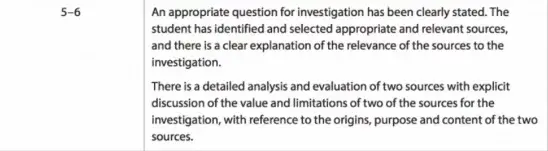
Immediately, the IB emphasises the importance of formulating an appropriate and clear research question. This means that your research question should be clearly posed as a question and phrased sensibly. Think about including the kinds of command words you see in IB exam questions, e.g. To what extent? How far? Examine…
You should also think about your sources. For your IA, you must select two sources (primary or secondary) for detailed analysis. Therefore your research question should be related to a topic on which there are plenty of sources you have access to for your investigation. This might seem obvious, but certain topics, such as life in Ancient Mesoamerica, may lack easy-to-access sources or may require specialist knowledge and/or translation. A good topic and research question should make selecting interesting and varied sources a relatively easy endeavour.
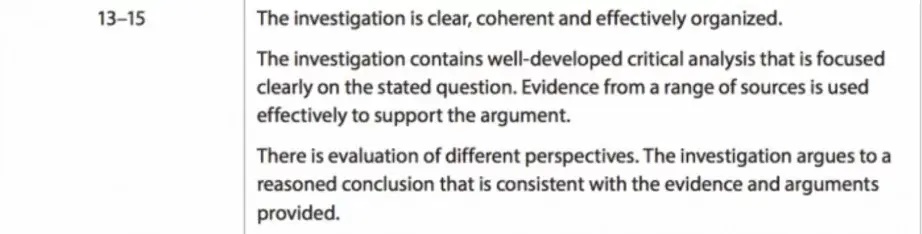
This section describes the important qualities that your investigation will need to get top grades. It must be a critical analysis that provides a clear evaluation of different perspectives and a well-reasoned conclusion. As a result, formulating a good question is very important for the investigation. The question needs to facilitate the exploration of multiple different arguments or different factors and have a possible answer.
For example, ‘What were the effects of the French Revolution?’ is not a very good research question because it encourages a description of events, not an evaluation. Moreover, it is far too vague. Your investigation needs to consist of a tightly constructed answer that you can articulate within 1,300 to 1,500 words. It would be much better for the question to have a narrower point of focus and include a specific factor which allows for debate, e.g. ‘To what extent did the French Revolution improve the lives of women?’
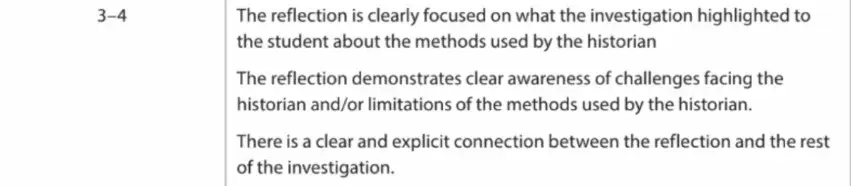
This final criterion matters the least for constructing your research question. However, it’s still worth looking at. The reflection is where students are expected to think critically about the methods used by historians and the challenges they faced during their own research. A good research question will naturally require you to put yourself in the position of a historian and should make writing the eventual reflection fairly easy!
Hopefully, you found going through the above criteria was a useful exercise! These are the points that you will be ultimately marked on and so should guide the entire process of researching, writing and editing for the History IA. However, here is a summary of the key steps that are needed for that first stage, finding a good research question:
In order to find a rich and interesting historical topic of interest, think about what interests you!
A really good way to do this is to look at a list of historical topics and pick out a couple (or more!) which stand out to you. History Today has a really good collection of articles that are organised by theme and period, which might strike your curiosity! Remember, at this point, you are just thinking about the broad topic, e.g. life under the Tudors or an event, e.g. The Bombing of Pearl Harbour War. We will then narrow this down through the next few stages.
After you have 2-3 topics you like, have a brief look to find what kind of sources are available. Are there any important primary sources like legislative bills, personal diaries or war reports that you could analyse? What about recent historical books and articles written by contemporary historians? Eliminate any topics where you are struggling to find useful sources.
Whilst you are considering the sources, you should also be thinking about what kind of controversies or questions they may reference. Historians are likely to directly reference such subjects of debate in their own work as they attempt to convince you with their own arguments. Do you agree with them? What do the primary sources say about this? If you believe that there is room to explore multiple interpretations or sides to this topic, then you have a good basis for an investigation!
Now it’s up to you to write your investigation! Use your selected sources and the key historical debate you found to write a short essay presenting your response to a particular question. You may find that your focus shifts as you write your answer. Watch out for this and think about whether or not you can slightly adapt your question, so it better fits the content you are actually writing about.
This question clearly states an investigation of a particular topic involving multiple perspectives. It identifies three key factors which are likely to form the three main talking points/paragraphs of its investigation.
The question introduces a core debate whilst focusing on a particular event, the Prague Spring, which its sources are likely to describe.
Very specific and narrow question about a particular decision. The sources used are likely going to be directly about what the ‘Halt Order’ was.
Okay, so this feels like this has been a very long blog for a seemingly simple task, coming up with a good research question. But, it shows how important it is to think so carefully about what the IB is asking for you. Here are some final top tips to leave you on:

Master your IB History IA with this ultimate guide. Get high-scoring topic ideas, structure advice, assessment criteria breakdown, and expert tips to avoid common pitfalls and achieve a 7.
Master the IB History IA with this expert guide. Learn how to choose a question, structure your analysis, and use our recommended word counts and IA examples.
Finding a great IB History IA topic is tough. Learn how to choose from 7 official topic types, use our 12-point checklist, and review 25 high-scoring IA examples.

Maximise your IB History study time with expert revision tips and strategy. Learn how to master essay practice and source analysis for Paper 1 and 2 exams.
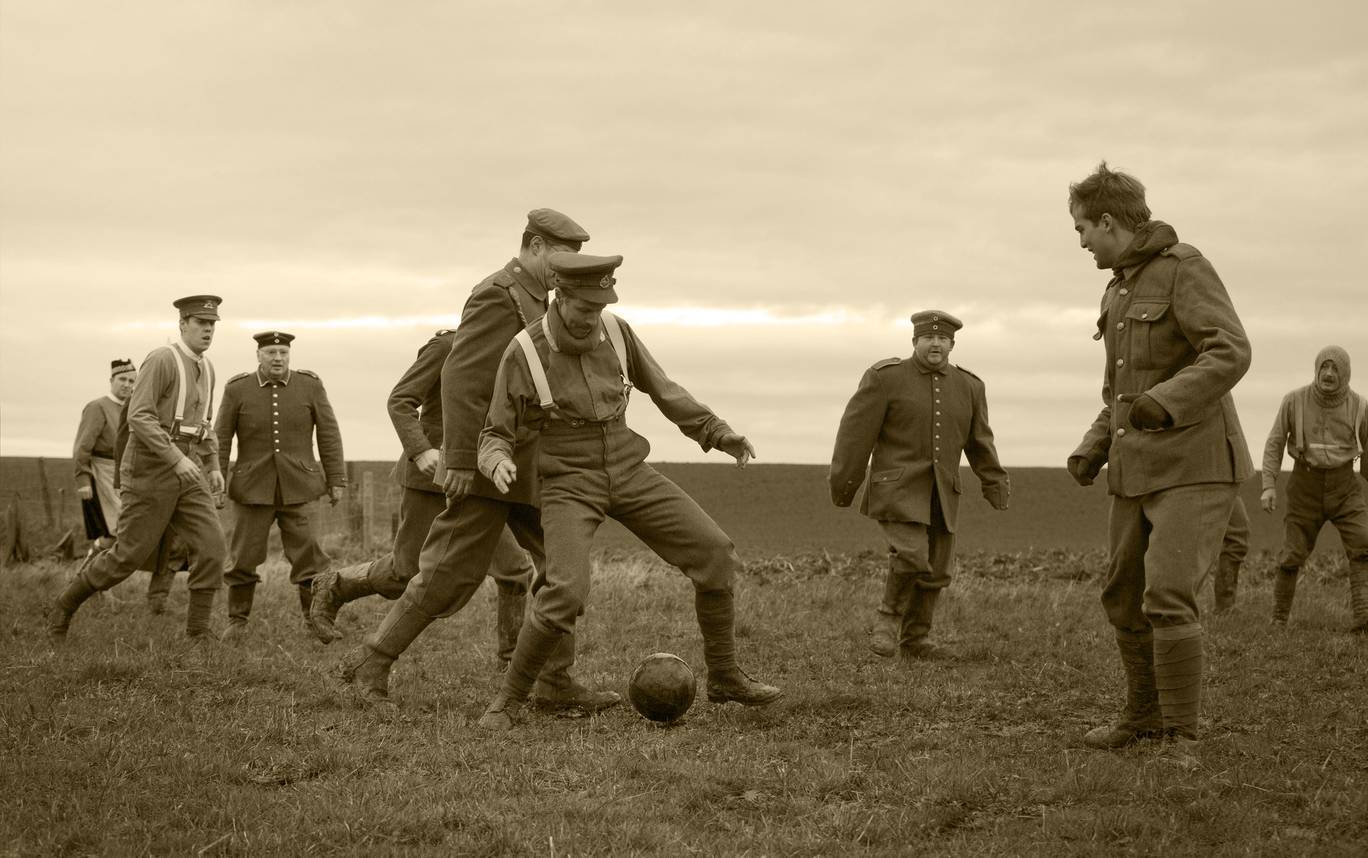
Master your IB History IA with 5 top tips from an expert tutor. Learn how to choose a strong topic, analyze sources, and structure your essay for top marks.

What is the Extended Essay (EE)? Get a complete overview of this mandatory 4,000-word research paper in the IB Diploma Programme core.

Struggling with your IB Extended Essay? Get inspired with 100+ Extended Essay Topics and learn the 10 steps for a top EE grade in your diploma.

Unlock A success with this comprehensive IB Extended Essay guide. Learn the 10 steps to writing a high-scoring EE, from research question to final draft.
600+ handpicked tutors from across the world with the best background and experience.


Geography shouldn't limit your potential. Lanterna provides premium online IB tutoring across the world, being partners with 250+ IB schools worldwide. Our country guides explore how the IB landscape shapes up and how our tutoring supports it perfectly.

1 hour of online tutoring in any subject with a 40+ IB graduate who scored a 7 in your subject.
No strings attached. By filling out the form you accept our T&Cs.
We are IB experts committed to achieving your academic goals.