
Graduates
- Scored 40+ in the IB and 7s in the subjects they teach.

Master your IB History IA with 5 top tips from an expert tutor. Learn how to choose a strong topic, analyze sources, and structure your essay for top marks.

Following on from our popular blog about tackling your Science IAs, this week I want to look at the History IA. For those of you studying the beast that is IB History, now is around the time that your teacher may start to introduce the IA task. Whether you’re studying HL or SL, all History students must complete it. The History IA is worth 20% of your final grade if you’re a HL student, or 25% if you’re studying at SL. So it makes up a hefty chunk of your overall grade.
When I was an IB student, I took the approach of working hard on my IAs to try and get as many marks ‘in the bag’ before my exams. And I want to encourage you to do the same! I promise it’s a comforting feeling knowing you’ve secured as many marks as possible before you’ve even sat an exam!
In this week’s blog I’m going to take you through my 5 top tips for success with the History IA.
As there is a free choice of topic with the History IA, it’s a great opportunity for you to explore your personal historical interests. Whilst having this freedom can be exciting, I know how it can also be quite daunting having to come up with an idea with no guidance! Here are a few ideas to get you on your way:

Source: www.independent.co.uk
Once you’ve decided on your topic, you must create a question to investigate. If we take one of my suggestions above, an example History IA question could be the following: To what extent did music drive the anti-war movement in America during the Vietnam War?
The only restriction is that your History IA cannot be on an event that has occurred in the last 10 years. Moreover, as this IA places great emphasis on analysis of sources, you must make sure that there are sufficient sources to support your investigation. More info on sources up next…
With the History IA, you need to select and analyse a range of source material and consider diverse perspectives. For me, an important point here is analysing a range of sources, as this will automatically make it easier for you to discuss diverse perspectives. Whilst it can be tempting to pick the first sources you come across when researching your topic, they might not provide you with thoughtful points to discuss in your IA. So it’s worth spending a fair amount of time to search for the most interesting sources to evaluate.
Remember to consider both primary and secondary sources. Primary sources provide a first-hand account of an event or time period, whilst secondary sources are interpretations and analyses based on primary sources. It’s also a good idea at this stage to think of the value and limitations of sources you come across. This is something you will have to discuss in Section 1 of your IA (more about the different sections to follow).
Here are some examples of sources you could include with your IA:
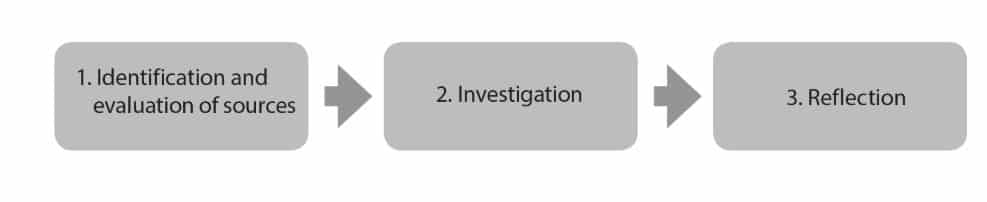
As you can see from the image above, the History IA is split into three sections. This provides a useful structure for your IA, and I recommend clearly labelling these three sections in your essay. It will help the examiner follow your IA much more easily, and make it clear to them that you have a strong grasp of what each section deals with! In short, here’s what you need to do in each section:
In addition, you must have a bibliography, but this is not included in the total word count (overall word count = 2,200). My top piece of advice is to write your bibliography as you go along. It is so boring (and time consuming!) having to go back and search for where your sources came from.
When completing your History IA, it’s a good idea to check that you’re meeting the assessment criteria. I know this is something I often talk about, but it is such an important point! By using the criteria descriptors like a checklist, you can ensure that you’re satisfying what the examiner wants in your work. Let’s take the History IA ‘Criterion A: Identification and evaluation of sources (6 marks)’ as an example. If you’re looking to be in the top band for this criteria, 5-6 marks, follow this description:
‘An appropriate question for investigation has been clearly stated. The student has identified and selected appropriate and relevant sources, and there is a clear explanation of the relevance of the sources to the investigation.
There is a detailed analysis and evaluation of two sources with explicit discussion of the value and limitations of two of the sources for the investigation, with reference to the origins, purpose and content of the two sources.’
Read through your Section 1: Identification and evaluation of sources. Scrutinise whether you have included everything to secure the maximum marks. If not, go back to your work and add in what’s missing!
In the IBO History IA guidelines students are actively encouraged to engage with their teachers throughout the IA process. It states:
‘Students should be encouraged to initiate discussions with the teacher to obtain advice and information’.
I think this is such a crucial point that many IB History students are unaware of/choose to ignore. Don’t be scared to approach your teacher and ask any questions you may have! They should be able to point you in the right direction, and might be able to introduce you to new sources for your IA. Which in turn, could lead to you producing a stronger IA and getting more marks in the bag!

In addition, your teachers are allowed to read and give advice on one draft of your IA. IBO rules state that the following version handed to your teacher must be the final version for submission. So, make sure your draft you hand in is as detailed as can be. Ideally, you want your teacher to give you as much feedback as possible. So handing in a fully written draft will probably be better than just giving in a plan!

Master your IB History IA with this ultimate guide. Get high-scoring topic ideas, structure advice, assessment criteria breakdown, and expert tips to avoid common pitfalls and achieve a 7.
Master the IB History IA with this expert guide. Learn how to choose a question, structure your analysis, and use our recommended word counts and IA examples.
Finding a great IB History IA topic is tough. Learn how to choose from 7 official topic types, use our 12-point checklist, and review 25 high-scoring IA examples.

Learn how to find a good research question for your IB History IA using expert tips, clear examples, and a breakdown of the official IB criteria for top marks.

Maximise your IB History study time with expert revision tips and strategy. Learn how to master essay practice and source analysis for Paper 1 and 2 exams.
Master IB History Paper 1 source analysis: Learn expert strategies, decode questions (Q1-Q3), use OPCVL for evaluation, and boost your mini-essay score.

Master IB History with this 5-step recipe for success! Learn expert revision tips on managing facts, planning essays, and leveraging your strengths for top IB grades.
.png)
A complete guide to the IB Internal Assessment. Learn how to choose a topic, manage your timeline, and structure your IA for a top grade. Includes tips for parents.
600+ handpicked tutors from across the world with the best background and experience.


Geography shouldn't limit your potential. Lanterna provides premium online IB tutoring across the world, being partners with 250+ IB schools worldwide. Our country guides explore how the IB landscape shapes up and how our tutoring supports it perfectly.

1 hour of online tutoring in any subject with a 40+ IB graduate who scored a 7 in your subject.
No strings attached. By filling out the form you accept our T&Cs.
We are IB experts committed to achieving your academic goals.