
Graduates
- Scored 40+ in the IB and 7s in the subjects they teach.

Master IB History with this 5-step recipe for success! Learn expert revision tips on managing facts, planning essays, and leveraging your strengths for top IB grades.

As far as IB subjects go, IB History is as challenging as it gets – but it doesn’t have to be. This guide provides a 5-step recipe for IB History success!
IB History is by far one of the most information-dense IB subjects. You're not only expected to learn decades of history but also to apply and analyse it. While improvisation may suffice in other subjects, in history, you need to know your facts.
Dates, statistics, and names relating to historical events should be an essential part of all the essays you write. You can only achieve this by writing detailed notes and revising them. Make sure to use flashcards, or any other memorisation techniques that work for you!
In addition to memorizing facts, you also need to learn how to discuss them. The best way to do this is to study what historians think about historical events. After all, they are experts in their fields, and they write the very books you study in class!
Learn from them by researching their perspectives on the topics you study. For instance, if you’re writing an essay on the causes of WW2, research what historians think the most important cause is. You’ll find that they have different opinions; one may think Germany caused it, while another disagrees. This is what makes history interesting! Pick the perspectives that align with your arguments, and weave these into your essays to reach the highest grades.
Once you have a wide range of facts and know different perspectives, you need to plan your essays! All three papers require you to write at least one essay, and there’s nothing more intimidating than being in an exam with no clue what to write. This can be stressful when you’re given as little as 45 minutes for each essay!
The good news is, you can predict what may come in an exam. For instance, for any type of war topic, make essay plans about the causes and consequences, as these are always on exams. This way, you’ll be prepared no matter which of the two you’re asked about. Identify key aspects you may be asked about, and plan out potential paragraphs using bullet points. Memorizing those will help greatly!
While you should always pay attention in class and learn from your teachers, you should also pay close attention to how you’re being taught. The history syllabus is huge, and no matter how excellent your teacher is, they will inevitably focus more on certain aspects of the syllabus than others.
For instance, your teacher may spend two months of course time on World War 1 and only two weeks on World War 2. In this case, you should likely avoid writing about WW2 on exams where you can choose, such as in Paper 2, and instead write about WW1.
If you have an abundance of facts on one topic but barely know the basics about another, then you should avoid your weaknesses and utilize your strengths. It is the teacher’s responsibility to give you information, but you must be clever and choose how you use it!
Lastly, you should try your best to simply enjoy learning history. At first glance, the abundance of facts and essay writing may make the subject seem boring and difficult, but it can also be incredibly interesting!
Try to interact with course material in fun ways, like watching historical documentaries, series, or movies about past events. This will help you to take a step back from your textbooks and put things into perspective. You’ll also fill in a lot of knowledge gaps by engaging with the material in abstract ways, which may help you to make connections with your coursework, and ultimately translate into better essays that discuss topics more fluently. While it may be difficult to find Hollywood dramas on subjects like maths, the selection for history is endless!
Even though the IB can be very challenging, if you stick by these five essentials, you’ll steamroll through your history classes with ease.

Master your IB History IA with this ultimate guide. Get high-scoring topic ideas, structure advice, assessment criteria breakdown, and expert tips to avoid common pitfalls and achieve a 7.
Master the IB History IA with this expert guide. Learn how to choose a question, structure your analysis, and use our recommended word counts and IA examples.
Master IB History Paper 1 source analysis: Learn expert strategies, decode questions (Q1-Q3), use OPCVL for evaluation, and boost your mini-essay score.
Learn how to find a good research question for your IB History IA using expert tips, clear examples, and a breakdown of the official IB criteria for top marks.
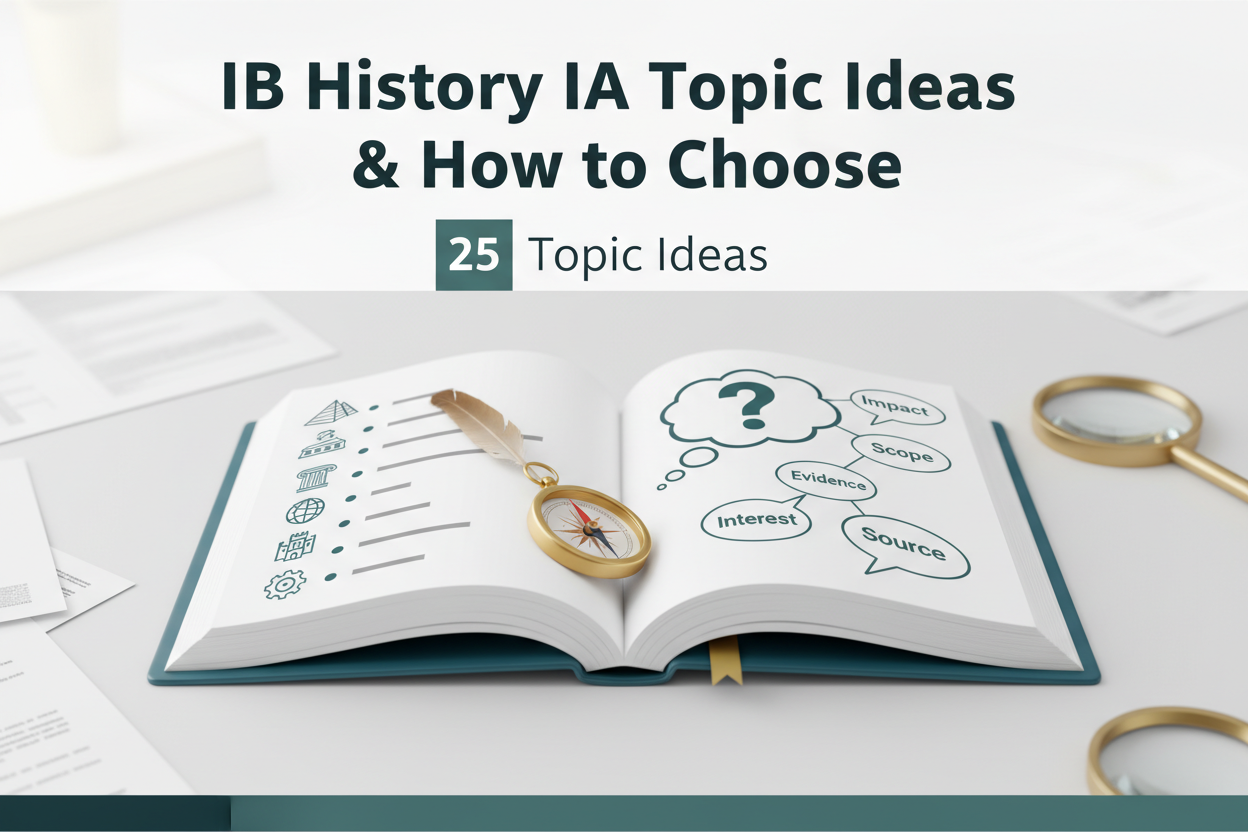
Finding a great IB History IA topic is tough. Learn how to choose from 7 official topic types, use our 12-point checklist, and review 25 high-scoring IA examples.

Maximise your IB History study time with expert revision tips and strategy. Learn how to master essay practice and source analysis for Paper 1 and 2 exams.
What is the Extended Essay (EE)? Get a complete overview of this mandatory 4,000-word research paper in the IB Diploma Programme core.

Master your IB exams by understanding key command terms. Our expert guide provides a complete list of definitions for terms like 'analyze', 'discuss', and 'evaluate'.
600+ handpicked tutors from across the world with the best background and experience.


Geography shouldn't limit your potential. Lanterna provides premium online IB tutoring across the world, being partners with 250+ IB schools worldwide. Our country guides explore how the IB landscape shapes up and how our tutoring supports it perfectly.

1 hour of online tutoring in any subject with a 40+ IB graduate who scored a 7 in your subject.
No strings attached. By filling out the form you accept our T&Cs.
We are IB experts committed to achieving your academic goals.