
Graduates
- Scored 40+ in the IB and 7s in the subjects they teach.

Master the IB Visual Arts Process Portfolio with our guide. See annotated examples, learn the difference between the Portfolio and Comparative Study, and get layout tips for top marks in Critical Investigation and Communication.
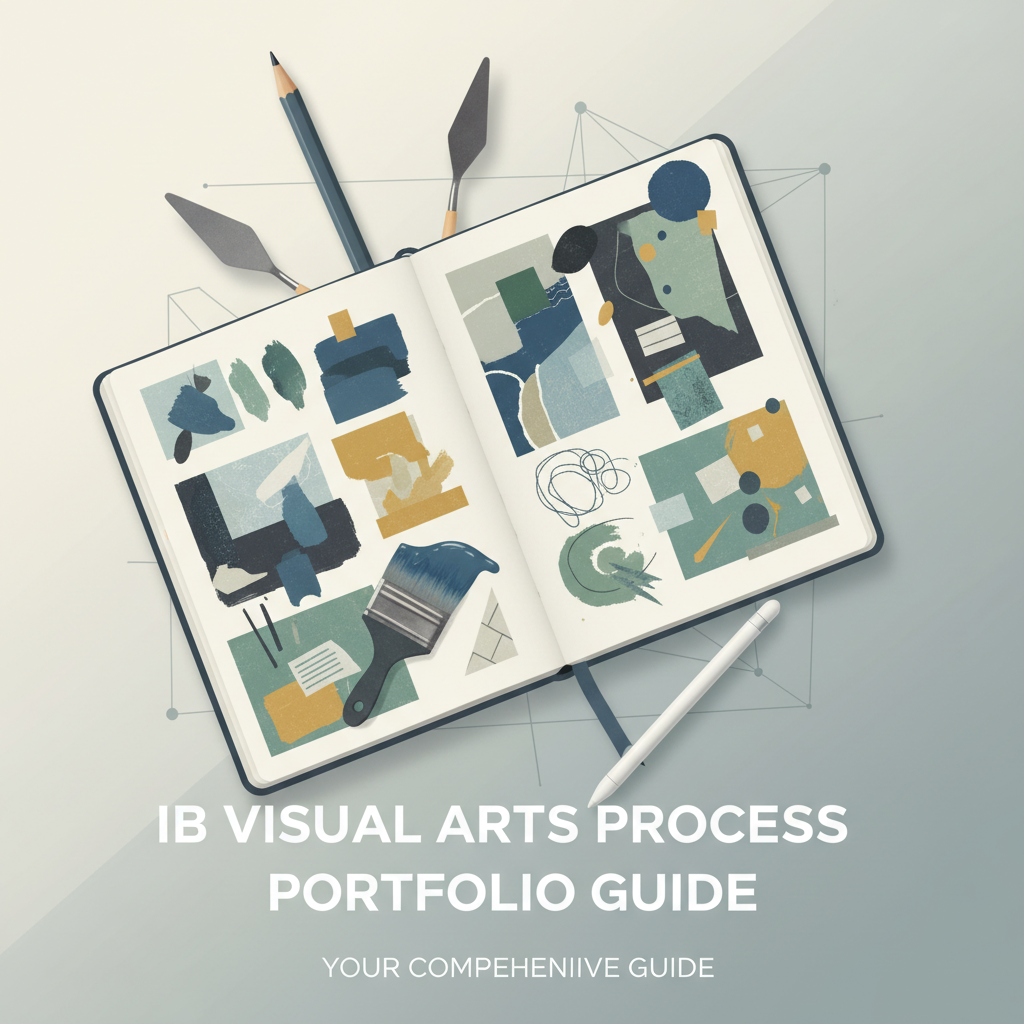
Welcome, aspiring IB Visual Artists! The Process Portfolio (PP) can feel like a huge task, but let's reframe it. Think of it as the ultimate opportunity to show off your artistic brain at work. It's not just about the final pieces; it's about the journey, the experiments, the 'aha!' moments, and even the 'oops, that didn't work' moments. As former IB grads and tutors, we've been through this, and we're here to give you the inside track on turning your creative process into a top-scoring portfolio.
This guide is your blueprint to mastering the Process Portfolio, helping you show the examiners the depth of your thinking and practice.
By using this guide, you will be able to:
Think of your Process Portfolio as your artistic diary. It's a carefully curated collection of screens that documents how you get from a tiny idea to a fully realised concept. It’s all about showing your experimentation, exploration, and refinement of different techniques and ideas over the two years. The main goal is to highlight the "how" and "why" behind your art – your journey, not just the destination.
This is a big deal. It's externally assessed and accounts for a massive 40% of your final IB Visual Arts grade.
You'll submit 9–18 screens. These must show work in at least two different art-making forms from separate columns of the art-making forms table (e.g., painting and digital art).
You'll submit 13–25 screens. These must show work in at least three different art-making forms, from a minimum of two columns of the art-making forms table.
It's easy to get these two mixed up, but they have very different jobs. Getting this right is crucial.
This is 100% about YOUR art-making journey. It focuses on your personal experiments, your reflections on your own practice, and how other artists inspire your studio work. It shows the evolution of your ideas and skills.
This is where you become an art historian. You analyze and compare artworks by OTHER artists from different cultures. The goal is to show off your analytical skills and reflect on how this research influences your own art.
In short: The PP is about your process. The CS is about other people's work informing your process.
To hit those top marks, your PP needs to nail two things: showing how you've investigated ideas and how well you communicate that investigation.
This is more than just sticking a picture of a famous artwork on a page. The examiners want to see you actively engaging with other artists to solve problems in your own work. Are you stuck on a technical issue? Look at how another artist solved it. Struggling with a concept? See how others have tackled similar themes.
Your PP is a visual story. The images should be the hero, with text playing a supporting role. You need to clearly show how your initial ideas grew and changed over time.
Remember, an examiner is viewing this on a screen. Presentation matters.
Let's break down what a strong screen might look like conceptually.
Visual: A series of photos showing you testing a new material. For example, three different attempts at a printmaking technique. Include the "failures"!
Annotation: "Here, I was experimenting with lino-printing to create texture. My first attempt (left) was too light because I didn't use enough ink. In the second (middle), I over-inked, losing detail. The third attempt (right) found the right balance. This taught me the importance of ink consistency for achieving the sharp lines I wanted for my theme of 'Urban Decay'."
Visual: An image of a sculpture by Antony Gormley next to your own clay maquette experiments.
Annotation: "I was inspired by Gormley's use of the human form to explore space. I investigated his casting techniques but decided to work with clay to create a more organic feel. My initial maquettes (left) were too literal. Influenced by his abstract forms, I began simplifying the figure (right) to better convey a sense of universal emotion, not just a specific person."
Visual: A sequence of images: an initial mind map, a few rough compositional sketches, and then a more developed digital mock-up of a final piece.
Annotation: "My project began with the broad theme of 'connection' (see mind map). My initial sketches explored this through intertwined hands, but this felt cliché. After receiving feedback, I shifted to using telephone wires as a metaphor for digital connection (see compositional sketches). This led to my final design, where I focused on the chaotic tangle of wires to represent miscommunication."
Want to secure that top grade? Here's our final advice.
.png)
A complete guide to the IB Internal Assessment. Learn how to choose a topic, manage your timeline, and structure your IA for a top grade. Includes tips for parents.
What is the Extended Essay (EE)? Get a complete overview of this mandatory 4,000-word research paper in the IB Diploma Programme core.

Understand IB Internal Assessments (IAs) and grading: learn how your teacher's guidance and the moderation process lead to your final, fair IB grade.

Find your perfect IB CAS project with our expert list of 50+ ideas. Explore examples for Creativity, Activity, Service, and combined projects to inspire you.

Need CAS Project Ideas for your IB diploma? Explore creative, activity, and service examples and learn the 5 stages to ensure a challenging and rewarding project.
.png)
Master IB note-taking with the ultimate guide. Discover top methods (Cornell, mind maps) and review essential apps (Notion, OneNote) to boost revision and study efficiency.

Struggling to start your IB IA? Learn how to plan your Internal Assessment effectively with our expert 5-point checklist for guaranteed success and better grading.

Mastering IB argumentative essays is key to top grades. Learn expert strategies for strong evidence, logical premises, and critical self-evaluation in your IB IAs and TOK Essay.
600+ handpicked tutors from across the world with the best background and experience.

Geography shouldn't limit your potential. Lanterna provides premium online IB tutoring across the world, being partners with 250+ IB schools worldwide. Our country guides explore how the IB landscape shapes up and how our tutoring supports it perfectly.

1 hour of online tutoring in any subject with a 40+ IB graduate who scored a 7 in your subject.
No strings attached. By filling out the form you accept our T&Cs.
We are IB experts committed to achieving your academic goals.