
Graduates
- Scored 40+ in the IB and 7s in the subjects they teach.

Master your IB History IA with our expert guide. Learn the structure, assessment criteria, how to find primary sources, and explore 50+ unique topic examples.
The History Internal Assessment can feel like the biggest challenge of your IB journey. It's an independent historical investigation, worth 20% of your final grade at HL and 25% at SL. But let’s reframe that: this is your chance to be a real historian. You get to choose a topic you're passionate about, dive deep into the evidence, and craft your own argument. This guide will walk you through every step, from picking a killer topic to polishing your final draft.
Your 2,200-word investigation is broken down into three distinct parts. Think of them as building blocks for your historical argument.
This is where you set the stage. You'll state your focused research question and then conduct a detailed analysis of two key sources you'll be using. For each source, you need to explain its relevance to your question and critically evaluate its origin, purpose, value, and limitations (we'll cover the OPVL method later!).
This is the main event—the body of your essay. Here, you'll present your argument, supported by evidence from a wide range of primary and secondary sources. The key here is critical analysis. You're not just telling a story; you're evaluating evidence, considering different historical perspectives, and building a case that directly answers your research question.
Time to step back and think like a historian. In this section, you reflect on the process. What challenges did you face? How did your understanding of historical methods change? You need to connect your personal experience with the investigation to broader questions about the nature of history itself, like the reliability of sources or the role of the historian's perspective.
Understanding the mark scheme is like having the rules of the game. Your IA is graded out of 25 marks, split into three criteria:
A great IA starts with a great question. A question that is too broad will lead to a descriptive, shallow essay. A question that is focused, specific, and debatable is the foundation for a high-scoring IA.
Follow this three-step process to narrow down your topic:
Primary sources are the raw materials of history—letters, diaries, government reports, photographs, speeches, and newspaper articles from the time. You need them to build your argument. You'll find them in online archives (like the Library of Congress), university digital collections, and databases like JSTOR.
To evaluate your sources like a top historian, use the OPVL method for your two chosen sources in Part 1:
| Component | What to Ask |
|---|---|
| Origin | Who created it? When and where was it created? Is it a primary or secondary source? |
| Purpose | Why was this source created? Who was the intended audience? What was it trying to achieve (e.g., inform, persuade, document)? |
| Value | Based on its origin and purpose, what makes this source valuable to your specific investigation? What insights does it provide? |
| Limitation | Based on its origin and purpose, what are the source's limitations? What perspectives does it ignore? What biases might be present? How does this affect its reliability for your question? |
Stuck for an idea? Use these focused research questions as inspiration. Notice how they all have a clear time, place, and theme.

Master your IB History IA with this ultimate guide. Get high-scoring topic ideas, structure advice, assessment criteria breakdown, and expert tips to avoid common pitfalls and achieve a 7.
Master the IB History IA with this expert guide. Learn how to choose a question, structure your analysis, and use our recommended word counts and IA examples.

Master your IB History IA with 5 top tips from an expert tutor. Learn how to choose a strong topic, analyze sources, and structure your essay for top marks.
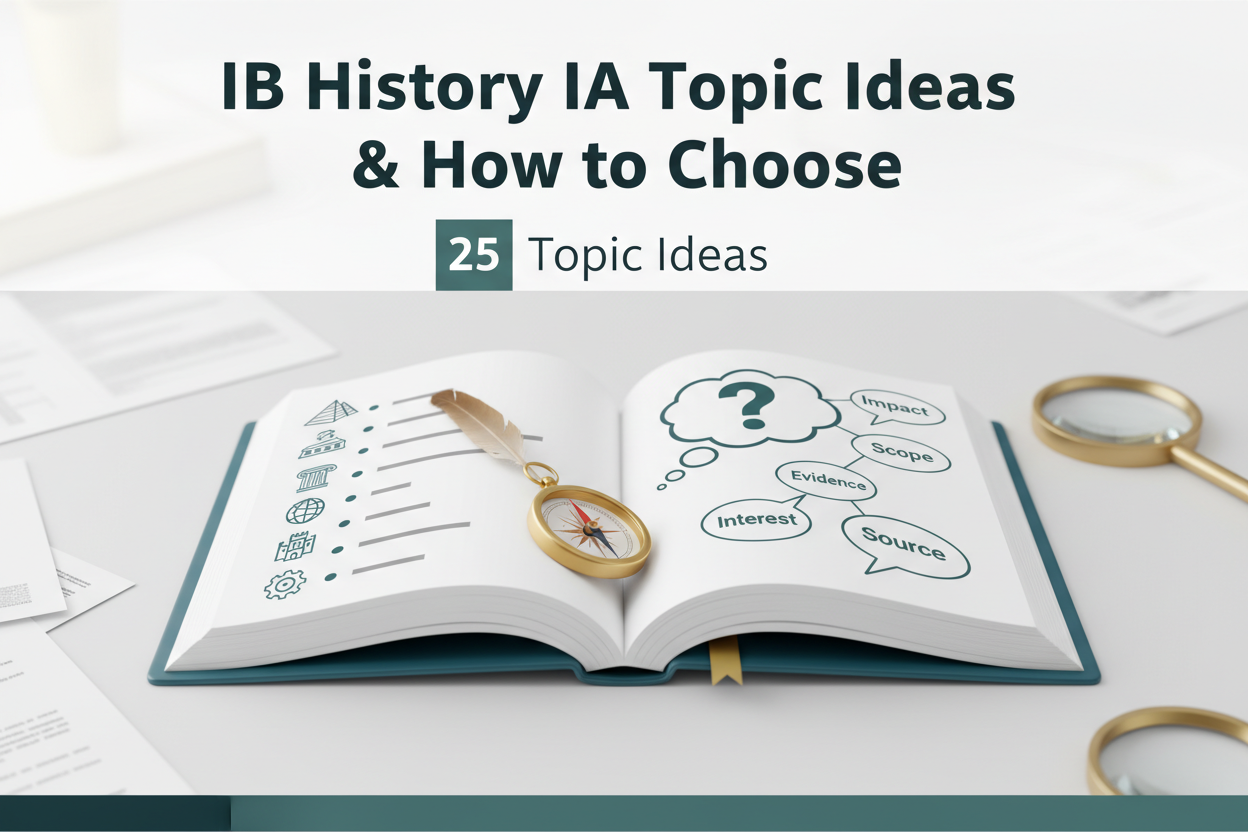
Finding a great IB History IA topic is tough. Learn how to choose from 7 official topic types, use our 12-point checklist, and review 25 high-scoring IA examples.

Learn how to find a good research question for your IB History IA using expert tips, clear examples, and a breakdown of the official IB criteria for top marks.
.png)
A complete guide to the IB Internal Assessment. Learn how to choose a topic, manage your timeline, and structure your IA for a top grade. Includes tips for parents.

Understand IB Internal Assessments (IAs) and grading: learn how your teacher's guidance and the moderation process lead to your final, fair IB grade.

Master your IB Science IA analysis by learning how to ace uncertainty calculations and data processing. Get expert tips to achieve top marks in Chemistry, Physics, and Biology.
600+ handpicked tutors from across the world with the best background and experience.


Geography shouldn't limit your potential. Lanterna provides premium online IB tutoring across the world, being partners with 250+ IB schools worldwide. Our country guides explore how the IB landscape shapes up and how our tutoring supports it perfectly.

1 hour of online tutoring in any subject with a 40+ IB graduate who scored a 7 in your subject.
No strings attached. By filling out the form you accept our T&Cs.
We are IB experts committed to achieving your academic goals.