Lanterna Education | Online IB Tutoring
DP1DP2StudentsTOKUltimate GuideStudy Skills

How to Structure Your IB TOK Essay Step-by-Step

Learn how to structure your IB TOK Essay step-by-step with this expert guide. Understand how examiners think and increase your TOK essay grading score with clear format tips.

Lanterna Team
January 27, 20264 min read
Banner

Structuring Your TOK Essay

TOK is, for many, an extremely difficult subject to get your head around. A lot of the questions you get asked in class might seem entirely nonsensical to you, and perhaps the TOK essay titles seem just as confusing! One thing that we at Lanterna think is the most under-appreciated thing that truly aids understanding and expressing those more confusing concepts is clear structure and format.

So many of the TOK essays we’ve seen students submit have had some great ideas but they seem too rambling and incoherent. Taking a few extra hours to address the structure of the essay is not just something that will make your essay ‘look’ better, but it will actually express your ideas much more clearly! What results is an examiner that clearly understands your viewpoint, rather than having to search for what you actually mean, and your grade is sure to increase! So… how do we structure and format our TOK Essay?

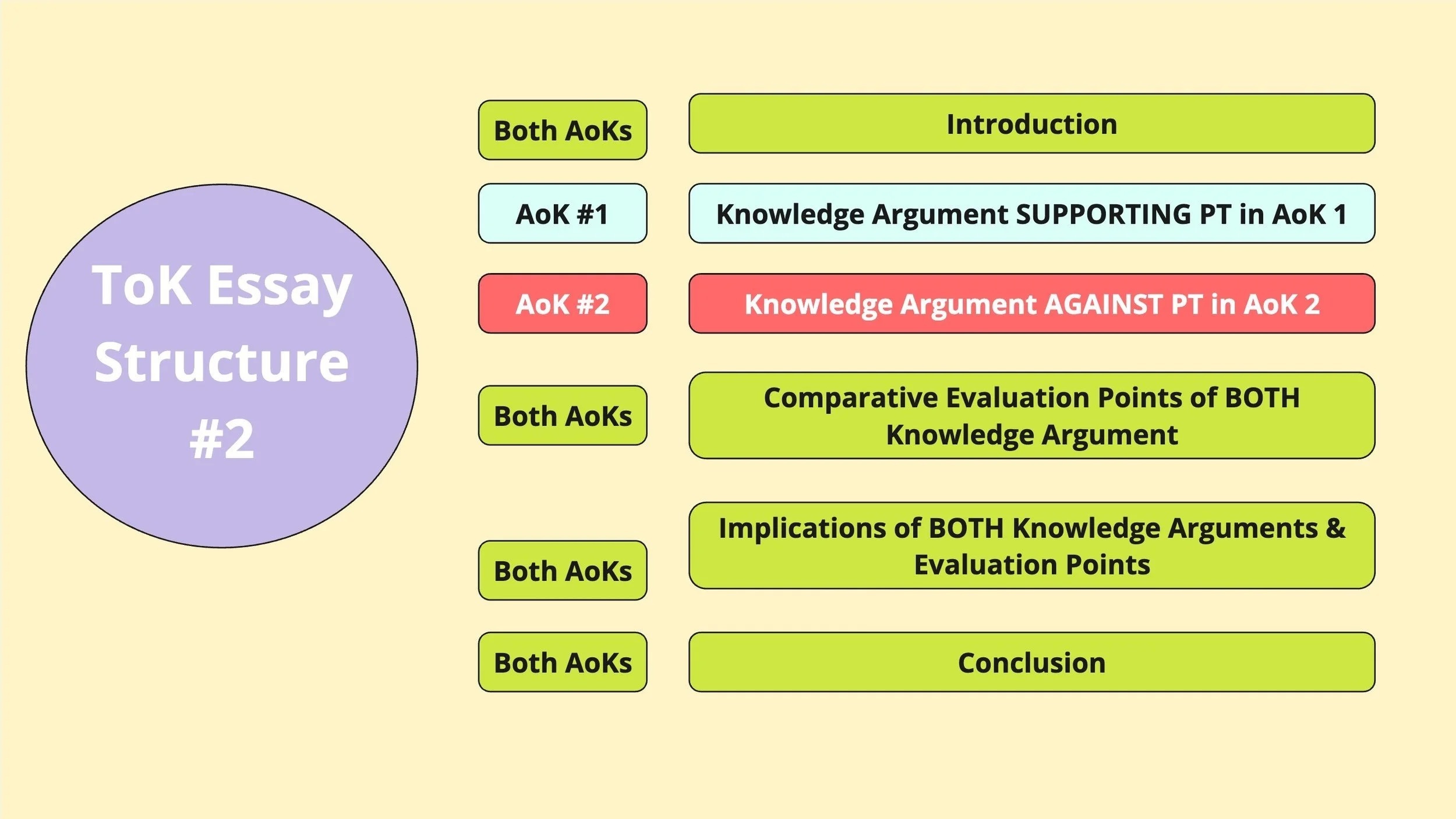
Introduction (150-200 words)

  • Start by focusing on the prescribed title (PT) – what catches your attention about it?
  • Define a few key terms from the prescribed title. Typically your PT will contain some words or phrases that aren’t easily definable, like “progress in knowledge” vs. “change in knowledge”, so the way in which you define these key terms is extremely important to the way that you then answer the PT.
  • Choose the AoK’s that you will consider related to this PT and perhaps a brief description of why you think these are good choices of AoK’s to discuss this title!
  • State your thesis – typically the PT will be a question that you can agree, disagree, or partly agree with.
  • Give a general overview of what you will be discussing in your essay, potentially referring to the real life examples (RLE’s) that you will consider, or the Ways of Knowing (WoK) that you will discuss further in your body paragraphs.

Body Paragraph 1 (250-350 words)

  • Explore the first AoK you chose. State why that AoK either supports or doesn’t support the PT.
  • Introduce a real life example
  • Explain why this real life example supports or doesn’t support the PT using WoKs
  • Talk about if this is a unique example, or if that example is true for most of that AoK.

Body Paragraph 2 (250-350 words)

  • Counterclaim to the example you gave above – explaining why it might be flawed or what downsides it might have
  • Introduce a real life example within the same AoK that counters the example in paragraph 1, using different WoKs
  • Refer back to the PT with a concluding sentence stating to what extent your first AoK supports or doesn’t support your thesis based on the example and counterexample you’ve highlighted.

Body Paragraph 3 (250-350 words)

  • Similar to Body Paragraph 1, explore your second AoK by bringing up a real life example, explaining it using WoKs, and evaluate

Body Paragraph 4 (250-350 words)

  • Similar to Body Paragraph 2, give a counterclaim to your previous example and then refer back to the PT showing whether your second AoK supports or doesn’t support your thesis.

Body Paragraph 5

  • If you have additional words to play around with then we’d recommend adding a body paragraph where you compare and contrast the 2 AoKs that you chose. Why is that they address the PT in different ways? Is it purely down to the WoKs we use when getting knowledge from those areas, or are there other factors at play?

Conclusion

  • Most importantly, refer back to the PT and your thesis. Through your analysis what is your response to the PT? Generally it’s unwise to come down extremely strongly on one side of the argument, as that probably implies that you’ve failed to recognize the arguments on the other side of the aisle. With that said, state what side you lean towards after your analysis and what examples backed that up!
  • Tell us why it’s important to know the answer to this question!

Every TOK Essay will look different and this isn’t the only format you can use for your essay. In fact, for some prescribed titles you might even want to steer away from this structure if the PT lends itself to another format! However, as a baseline, this is a clear, well-thought out way to approach the confusing essay that is your TOK Essay. Let us know if you have any more questions about the TOK Essay and we’ll be happy to help you out! Good luck!

Related to How to Structure Your IB TOK Essay Step-by-Step

IB TOK Essay Structure Guide
TOKUltimate GuideStudy SkillsDP1DP2Students

IB TOK Essay Structure Guide

Master the IB TOK Essay structure with our complete guide. Get step-by-step outlines for your introduction, AOK paragraphs (claims/counterclaims), and conclusion to hit top markbands.

Master IB TOK Guide
TOKUltimate GuideIAsDP1DP2StudentsParents

Master IB TOK Guide

Master IB Theory of Knowledge (TOK) with our complete guide. Learn about the curriculum, areas of knowledge, and ace your TOK exhibition and essay with structure tips and examples.

TOK Essay: A Complete Guide to Acing the IB TOK Paper
TOKUltimate GuideStudy SkillsDP1DP2StudentsParents

TOK Essay: A Complete Guide to Acing the IB TOK Paper

Master the IB TOK Essay with this complete expert guide. Learn how to structure your paper, understand grading criteria, and use critical thinking skills to achieve your diploma.

How to Write Your IB TOK Essay: Tips
TOKStudy SkillsUltimate GuideDP1DP2Students

How to Write Your IB TOK Essay: Tips

Write your IB TOK Essay with confidence. Learn essential tips on choosing a title, understanding IB criteria, and structuring your argument for top marks.

TOK Essay: How to write the IB TOK Essay
TOKUltimate GuideStudy SkillsDP1DP2Students

TOK Essay: How to write the IB TOK Essay

Learn how to write the IB TOK Essay using expert tips on terminology (WOKs/AOKs) and structure. Master this challenging assignment with confidence.

Complete Guide to IB Theory of Knowledge Frameworks
TOKUltimate GuideAbout IBDP1DP2Students

Complete Guide to IB Theory of Knowledge Frameworks

Master IB Theory of Knowledge Frameworks. Learn how to apply the structure of the Areas of Knowledge (AoKs) in your essays and presentations for top results.

Complete Guide to IB TOK Areas of Knowledge
TOKMathsSciencesHumanitiesDP1DP2Students

Complete Guide to IB TOK Areas of Knowledge

Learn how to master the IB TOK Areas of Knowledge. Expert guide to understanding the AoK framework, features, and key debates for your TOK essay.

Complete Guide to IB ToK Areas of Knowledge: Arts & Ethics
TOKUltimate GuideArtsDP1DP2Students

Complete Guide to IB ToK Areas of Knowledge: Arts & Ethics

Master the IB ToK Areas of Knowledge: Arts, Ethics, Religious Knowledge, and Indigenous Knowledge. Learn critical approaches and key concepts for ToK success.

Perfectly Matched Tutors

600+ handpicked tutors from across the world with the best background and experience.

Graduates

Graduates

  • Scored 40+ in the IB and 7s in the subjects they teach.

Teachers

Teachers

  • Certified educators with an average of 15 years experience.
Elite

Elite

  • Teachers with IB examiner experience or senior markers
Free IB tutoring trial

Your first hour,
on us.

1 hour of online tutoring in any subject with a 40+ IB graduate who scored a 7 in your subject.

15,000+ students
96% recommend Lanterna to friends & family

No strings attached. By filling out the form you accept our T&Cs.

Stockholm born, Globally present

We are IB experts committed to achieving your academic goals.

about us