
Graduates
- Scored 40+ in the IB and 7s in the subjects they teach.

Learn how to structure your IB Extended Essay Outline with expert planning techniques. Master your EE with bullet-point, post-it, and spreadsheet methods for success.

When it comes to writing a brilliant first draft of your Extended Essay, or any essay, I fully believe that a solid structure is one of the surest guarantees of success there is. It’s the skeleton of the essay that makes it into a fully formed being instead of a pile of jelly. And the best way to make sure you have a skeleton instead of just gelatine (is that a rhyme?) is to create a plan or outline.
We’ve talked about how to choose a topic, go about your research, and pin down a research question. So now we’re going to address how you can take all of that work and turn it into a concrete plan. It’s all about organising your ideas so that they are as clear as possible. After you’ve done this, writing the essay will be about simply filling in the gaps!
Although your research question should already suggest what you are aiming to achieve in the essay, your conclusion needs to take this a step further. It can’t just be the same as your introduction but in different words (as tempting as that option is!). Everything in your essay should take the reader on a journey to this conclusion. It should help progress your argument so that we get closer with every paragraph.
If you’re now realising that you don’t know your destination, take the time to figure this out before you start writing. The results of a Science experiment will make it pretty obvious, but even in more subjective subjects such as English, History and World Studies you need to decide what conclusion your research points towards.
My advice to you, if you simply aren’t sure, is to follow your instincts. Think about how your evidence has affected what you personally think about the topic. Chances are it will have convinced you of something.
Exercise 1: summarise your conclusion in one sentence. Even if it’s not exactly right, or if it doesn’t include everything you feel is important about your topic, compress it as much as you can into one core idea. If you can’t do this right away then set a timer for five minutes and start drafting sentences about what you ‘think’ your essay might conclude. At the end of the five minutes pick the one that you feel summarises it best.
Take a moment to free your mind from all the details, facts, quotes and data. Go back to the essence of your essay, which is the argument you are trying to make. Without using your research to speak for itself, identify all the different ideas you want to include, and the things you want to say.
For example, you might have evidence that Virginia Woolf uses imagery of flowers frequently throughout Mrs Dalloway, but what does this actually mean in the context of your question? The idea behind it might relate more to her affinity with nature, or the parallels she draws between flowers and people.
Exercise 2: write down all the ideas you want to include in your essay. Don’t worry about an order yet. Focus instead of getting all of your ‘points’ written down somewhere. Not only is this likely to help your organise your thoughts, but it will also mean you can refer back to it later to make sure you haven’t forgotten one of your favourite ideas! This can take the form of a mind map, a list, a Word Doc. Do whatever feels easiest, because chances are this is what will help your ideas flow naturally.
I can 99% guarantee you that you won’t be able to use all the research you have done. A lot of it will be:
THEREFORE it is important that you filter your evidence so that you only have the best examples and information.
Use your research question as your starting point and your conclusion sentence (the one you wrote earlier) as the end point. It is your job to make sure that every piece of research is part of a bridge between the two. Absolutely every quote, fact or piece of data that you include should actively answer your question. If it doesn’t, don’t include it.
Exercise 3: First, highlight the clearest, most informative research that you have gathered. Next, take all of these pieces of research, and write a short, one-sentence summary next to each one, describing how it relates to your question. Use your own words. You will hopefully start finding that they are backing up some of the points you know you want to include.
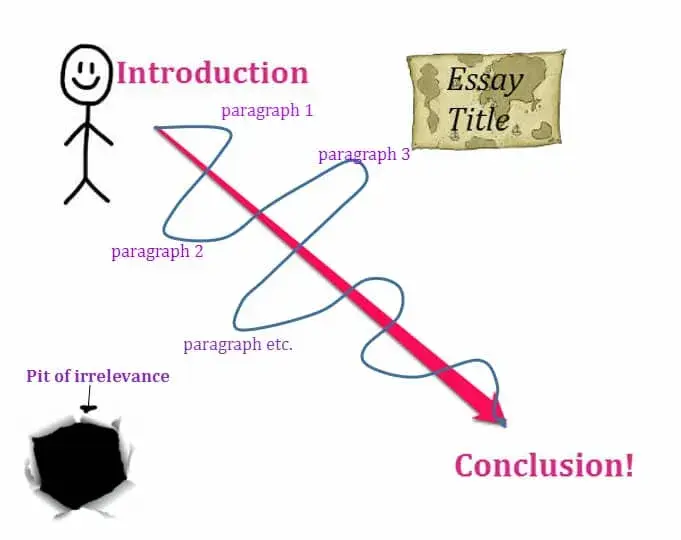
There are different techniques you can use to structure an essay. Because the Extended Essay is much longer than what most of you will be used to, I strongly recommend using a particular technique or process to do this. Below are some examples, and you should do whatever works best for you.
You know this one. It’s the most classic example of how to structure an essay and the one most of you have probably tried before. The trick with this one is to start small and expand outwards afterwards.
I’m defining this as anything that involves you breaking down your paragraphs into defined pieces. Post-it notes, cards, and scraps of paper are the most common examples. This option is brilliant if you struggle coming up with an order for your ideas straight away. Instead it lets you play around with all the different parts of your essay as you go, until you have put them in the best possible order.
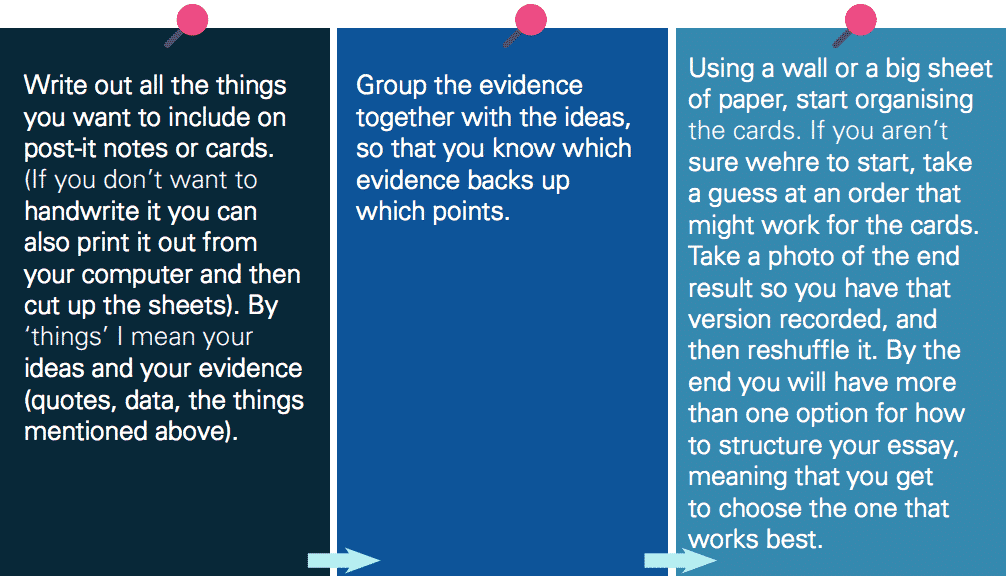
If you like the idea of this process but can’t stand the idea of lots of physical pieces of paper, there are some apps that perform a similar function such as Gingko or Evernote.
For the structure nuts among you. The beauty of this is that it lets you easily compare paragraphs in terms of length and content by breaking each one down into clear sections. You can choose how exactly you format it, but it might look like this:
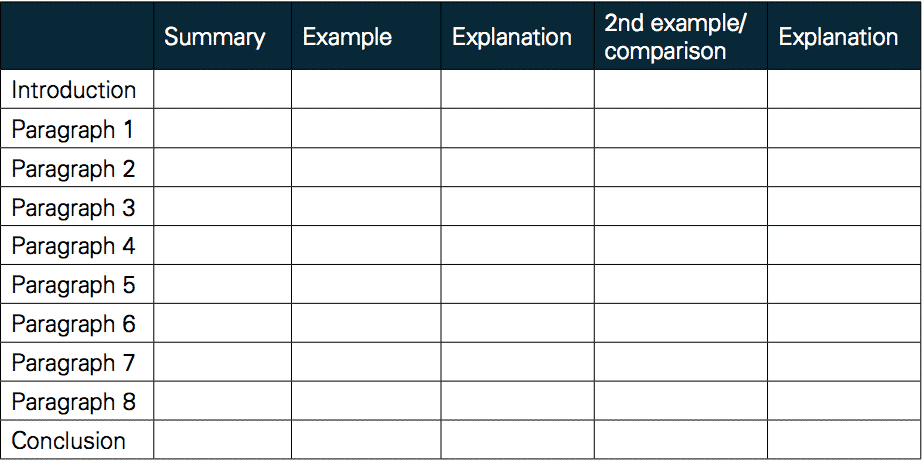
As with the post-it version it is super easy to use this method to change the order of your paragraphs. You can also tailor the columns depending on what categories are most relevant to you. If you want to go a step further you can even colour code your sheet, for example according to 1st hand data or 2nd hand data, or close analysis and thematic analysis.
The key is to have a view of the bigger picture of your essay. How you go about it is up to you!

What is the Extended Essay (EE)? Get a complete overview of this mandatory 4,000-word research paper in the IB Diploma Programme core.

Struggling with your IB Extended Essay? Get inspired with 100+ Extended Essay Topics and learn the 10 steps for a top EE grade in your diploma.
Unlock A success with this comprehensive IB Extended Essay guide. Learn the 10 steps to writing a high-scoring EE, from research question to final draft.

Learn how to write a strong IB Extended Essay Proposal. Get expert guidance on topic selection, research questions, project timelines, and resources needed.

Learn how to master your IB Extended Essay research question with 5 essential tips from an expert tutor. Perfect your RQ and boost your EE grading potential.

Learn how to write your IB Extended Essay (EE) with 8 expert steps, including mastering the PEEL method and using the marking criteria for a top grade.

Find your perfect IB Extended Essay idea! Discover 25 unique EE topics across Chemistry, Psychology, English, and Physics to spark your inspiration and conquer choice paralysis.

Master your IB Extended Essay research question. Learn how to draft, refine for clarity and precision, and ensure examiner approval with this expert guide.
600+ handpicked tutors from across the world with the best background and experience.


Geography shouldn't limit your potential. Lanterna provides premium online IB tutoring across the world, being partners with 250+ IB schools worldwide. Our country guides explore how the IB landscape shapes up and how our tutoring supports it perfectly.

1 hour of online tutoring in any subject with a 40+ IB graduate who scored a 7 in your subject.
No strings attached. By filling out the form you accept our T&Cs.
We are IB experts committed to achieving your academic goals.