
Graduates
- Scored 40+ in the IB and 7s in the subjects they teach.

Learn how to write your IB Extended Essay (EE) with 8 expert steps, including mastering the PEEL method and using the marking criteria for a top grade.

Let’s face it, it’s haunting. All of a sudden you find yourself coming to terms with one of the IB’s most feared tasks: the Extended Essay.
Where to start? How do I choose a topic? How do I make sure I choose the right subject?
Luckily for you we are here to give you tips and tricks to make the whole process as stress-free as possible and, who knows, maybe even enjoyable.
Here are 8 top tips that have helped me through my journey of writing my Extended Essay in English Language and Literature, from beginning to end – and I even enjoyed it!
While it should be noted that your Extended Essay should be written for one of your Higher Level (HL) subjects, there are plenty of ways you can pinpoint which one of these should be your Extended Essay subject.
Is there a particular HL subject you perform best in?
Is there a topic you are particularly passionate about?
These are the first two steps to start writing a powerful EE. Do you feel lost? We give you more than 100 Extended Essay topics and ideas.
When you have identified a topic and subject, the FIRST thing you should do is study the marking criteria for the Extended Essay in your designated subject.
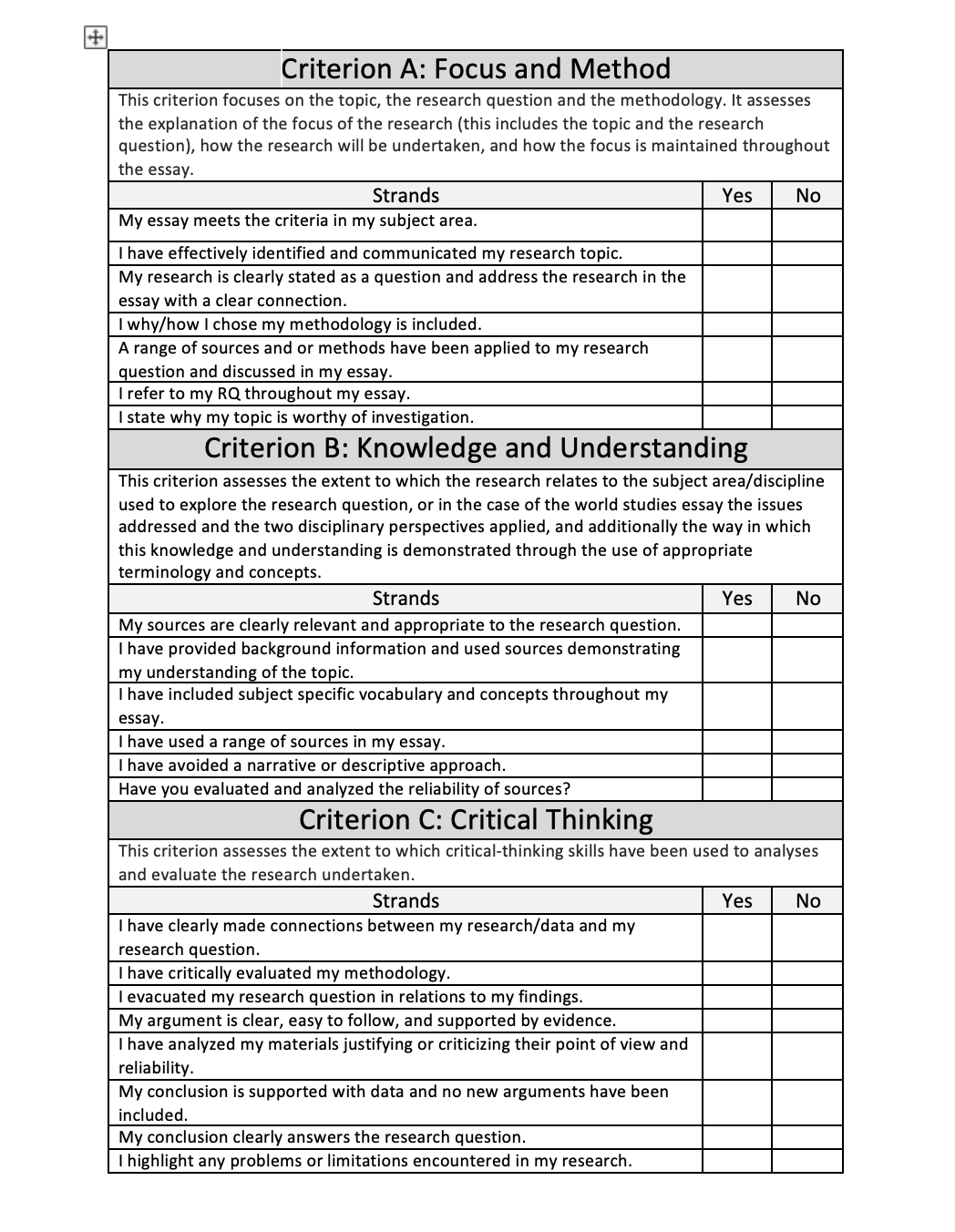
Pinpoint which elements of the markscheme are essential for a successful essay, and make a personal checklist that you can go back to when you are writing, to make sure you are always referring back to what the examiner is expecting from you.
Here is a simple example of what your EE checklist could look like:

No matter what your subject area is, your Extended Essay needs a CLEAR and concise subject in the form of a direct question.
This is important because you will tailor your research to answering the question. In other words, how well you answer your research question in your essay will dictate how successful you will be with your performance in the Extended Essay.
I remember the struggle and the frustration of having an insanely long first draft where I would get lost.
Don’t worry, it’s totally normal. Give yourself the space to experiment with your arguments and start with a flexible plan, in order to allow some space for modifications as you build up a bibliography and make sense of your sources.
Just make sure that when you find an argument that clicks, you stick to it and try not to cover too many areas all together. Focus is key, and less is more.
When you have a solid draft and you have allowed yourself to choose your arguments, make sure to pinpoint your primary and secondary sources in the introduction. Guide your reader step by step, and don’t take any information for granted.
The Extended Essay is about two things: properly answering your Research Question and abiding to marking criteria.
To do the latter, you have your checklist. How to you make sure you answer you RQ correctly? Using the PEEL method.
This will allow for a solid structure, coherent argument and clear ideas.
One of the best ways to proofread is to print your EE drafts and use different coloured pens to identify each PEEL component. If one color is absent, you know what you have to work on. Mind the Link component. At the end of each paragraph, always ask yourself if you have answered your research question and if it links correctly to your next paragraph.
You have a lot of liberty when it comes to formatting your EE. You can choose a font that most suits the tone you are aiming for, and use a table of contents, pictures and citations to make it formal and easy to follow.
Now that you know all the tips and tricks, dive into your Extended Essay with no fear, and enjoy it!

What is the Extended Essay (EE)? Get a complete overview of this mandatory 4,000-word research paper in the IB Diploma Programme core.

Struggling with your IB Extended Essay? Get inspired with 100+ Extended Essay Topics and learn the 10 steps for a top EE grade in your diploma.

Unlock A success with this comprehensive IB Extended Essay guide. Learn the 10 steps to writing a high-scoring EE, from research question to final draft.

Learn how to write a strong IB Extended Essay Proposal. Get expert guidance on topic selection, research questions, project timelines, and resources needed.

Learn how to structure your IB Extended Essay Outline with expert planning techniques. Master your EE with bullet-point, post-it, and spreadsheet methods for success.

Learn how to master your IB Extended Essay research question with 5 essential tips from an expert tutor. Perfect your RQ and boost your EE grading potential.

Find your perfect IB Extended Essay idea! Discover 25 unique EE topics across Chemistry, Psychology, English, and Physics to spark your inspiration and conquer choice paralysis.

Master your IB Extended Essay research question. Learn how to draft, refine for clarity and precision, and ensure examiner approval with this expert guide.
600+ handpicked tutors from across the world with the best background and experience.


Geography shouldn't limit your potential. Lanterna provides premium online IB tutoring across the world, being partners with 250+ IB schools worldwide. Our country guides explore how the IB landscape shapes up and how our tutoring supports it perfectly.

1 hour of online tutoring in any subject with a 40+ IB graduate who scored a 7 in your subject.
No strings attached. By filling out the form you accept our T&Cs.
We are IB experts committed to achieving your academic goals.